





Help to Save
Government scheme offers a 50% savings bonus for low-income earners

The Help to Save scheme gives low-income earners a savings boost, giving eligible Universal Credit claimants a 50% Government bonus on the highest balance they build over time – worth up to £1,200 across four years. It’s designed to help you build a small emergency buffer at your own pace, with flexible deposits of up to £50 a month and the option to withdraw if needed, while still keeping the bonus based on the peak amount you’ve managed to save.

First, a quick overview of the Help to Save scheme...
We've pulled out the key info here, or see our full guide below for in-depth information.
How does Help to Save work?
Save up to £50/month. It’s easy-access, so you can withdraw cash if you need to.
First 50% bonus paid after two years. Based on the highest balance during the first two years (max £600 bonus).
Second 50% bonus paid after four years. Based on the difference between the highest balance in years three and four and the highest balance during the first two years (max £600 bonus).
Total possible bonus: up to £1,200 over four years.
How do I qualify for Help to Save?
You currently qualify if you:
Are a UK resident
Receive Universal Credit, and
Earned £1 or more in your last monthly assessment period (this applies to both partners if it’s a joint claim).
How do I apply?
Online at Help to Save on Gov.uk. It'll need you to sign in to your Government Gateway account (the same details you use for your personal Universal Credit) – or you can call HM Revenue & Customs (HMRC) on 0300 322 7093.
Alternatively, you can use the HMRC app – our full guide on the HMRC app explains how to get it and how to get the most out of it.
The Autumn Budget confirmed a major expansion to Help to Save from April 2028 – see below for exactly what’s changing.
What is the Help to Save scheme?
Help to Save is a type of savings account for low-paid workers, designed to reward you for putting a little away when you can. You can save anything from £1 to £50 a month, and you don’t need to pay in every month. After two years, you’ll get a 50% bonus on the highest balance you’ve had – and you can earn up to £1,200 in bonuses over four years. It’s also easy access, meaning you can dip into your savings when you need to.
Here's a helpful illustration to show how it could work in practice:
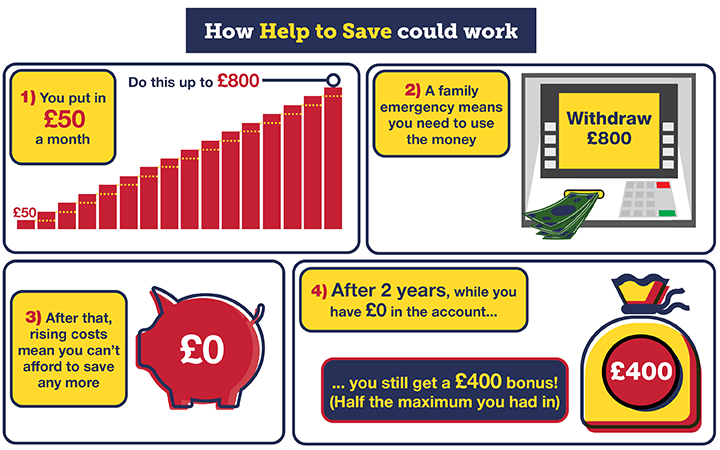
Or, you can watch Martin's three-minute video briefing, where he breaks it all down:


A 50% bonus sounds great. What's the catch?
No catch, though the bonus has a couple of strange twists. Here's how it works...
After two years, you'll get the first 50% bonus paid into your bank account (not into the Help to Save account). Once that's been paid, you can either decide to stop saving, or you can keep saving into it for another two years. Again, you can save between £1 and £50 a month, but you don't have to save every month. If you keep saving, you could get another bonus paid at the end of the four years.
Two important things to note:
-
The bonus for the first two years is paid on the highest amount you've had in the account during the two years, not the amount that's there at the end – though these could be the same.
For example, if you'd managed to save £1,000, but needed to withdraw £200 before the end of the two years, despite having a balance of £800 at the end, you'd still get a £500 bonus, as that's 50% of your highest balance, which was £1,000.
-
The bonus in the second two years is paid on the amount that your highest balance in years three and four (let's call this balance A) exceeds your highest balance in years one and two (balance B). The bonus is 50% of the difference between balance A and balance B at their highest. This is how it could work in practice...
Let's assume you managed to save £500 in years one and two – you'd get a £250 bonus paid out at the end of the second year. But you needed to use the £500 for car repairs, so withdrew it all.
Then, in years three and four, you found you could start saving again and managed to save £750. In this case, you'd get a £125 bonus (this is worked out as £750 - £500 = £250, the bonus being 50% of the difference between your two highest balances).
The first set of bonuses were paid in September 2020, as the first accounts opened were due their two-year bonus. Since then, more bonuses have been paid, with the average amount sitting at £378 – a decent addition to anyone's savings.
Do I qualify for Help to Save?
To qualify for Help to Save, you must:
Be a UK resident, or be posted overseas as a Crown servant or with the armed forces (or be their spouse or civil partner).
Receive Universal Credit
Have earned income of £1 or more in your (or your and your partner’s, if it’s a joint claim) last monthly assessment period.
You only need to meet the eligibility criteria when you open the account. If your circumstances change later, you can still continue saving and earn the government bonus. However, Help to Save accounts are individual, and cannot be opened jointly.
Help to Save is being expanded – but not until April 2028
The Autumn Budget, confirmed that Help to Save is being widened – but the change won’t take effect until April 2028. When it does, it’s expected to bring around 1.5 million additional people into eligibility, focusing on Universal Credit claimants who can’t work because they’re caring for children or providing substantial care to someone with a disability.
The new groups set to qualify from April 2028 are:
UC claimants who receive the ‘child’ element. This covers parents, kinship carers and grandparents who have day-to-day responsibility for children under 16, or under 19 if the young person stays in approved education. It brings the scheme into line with UC rules that recognise childcare responsibilities as a barrier to work.
UC claimants who receive the ‘carer’s’ element. This applies to people who provide 35+ hours of care a week to someone with a disability. It reflects that caring duties can limit someone’s ability to take on paid work.
People receiving Carer’s Allowance alone won’t qualify, as it’s not means-tested – but many may still be eligible for Universal Credit, depending on household circumstances. It’s worth doing a benefits check to see if they could qualify now or once the expansion begins.
Not sure if you're eligible?
Don’t worry – your eligibility is checked as part of the application process and you won’t be able to apply unless you’re eligible for the account. So if in doubt, give it a go.
If you're unsure whether you qualify for Universal Credit, check our Universal Credit guide and/or our Benefits Calculator.
Should I use Help to Save if I have debts?
This is our one concern about the scheme. Here's the view of MoneySavingExpert.com founder Martin Lewis...

'It's possible to get the best of both worlds'
The great concern with Help to Save was that it would encourage people to save when they should instead be paying off debts, including some extremely expensive ones like payday loans, high cost credit or poor credit credit cards. Yet they've managed to work a structure that lets people possibly have the best of both worlds.
The fact that you're given the bonus based on the highest amount you've saved, rather than the amount that you actually have in there, means you can build up your savings until you have an emergency that you would otherwise have borrowed for, and then use your savings instead of borrowing. But you'll still be rewarded for the fact that you saved in the first place.
It's a very clever scheme and one that will work for many people. Of course though, if you've extremely expensive debts, rather than saving, it's best to try and clear those first.
If you've debt problems, whether you're struggling to meet minimum repayments, you owe more than you earn in a year or it's affecting your ability to sleep at night, Help to Save isn't going to be the right answer. Instead, read our Debt Help guide.
My debts are on a credit card at 0% interest. Should I use Help to Save?
This depends on when your 0% offer runs out. If it's in two years' time or longer, and you plan to use the savings and bonus to clear the debt before you start paying interest, Help to Save could be a good savings plan. However, always remember to pay at least the minimum payment on your credit card – check you can afford this and also to save.
Shorter 0% periods may also work if you can save enough to pay off the card at the end of the 0% period. Remember, even if you've withdrawn cash before the end of two years, you'll still get a bonus on the highest balance you had in the account.
Is there ever a time when it makes sense to use Help to Save rather than pay debt?
If you've debts but you're paying them off and want to know if this is a better option, read on. But before we get into the maths, it is worth saying that even if you'd be financially better off saving to get the bonus, you may feel better psychologically if you're paying down your debt, rather than waiting two years while the interest's racking up all the time. If that's the case for you, Help to Save isn't the right answer, paying off debt is.
Let's look at how Help to Save compares to a sample credit card...
Let's assume you have a £1,200 debt on a card charged at 19.9% APR. Making no repayments (though in practice this is not how a credit card works), after 24 months you'd owe around £1,725.
In Help to Save, after two years saving the maximum £50/month, you'd have £1,800 (£1,200 saved + £600 bonus). You could then use the savings + bonus to pay off the debt.
Alternatively, if you'd used the £50/month to pay down the debt, at the end of the two years you'd still owe around £290 on the credit card (having paid just under £300 in interest).
Of course, this is just an example assuming a constant debt and a large enough credit limit to accommodate the extra interest, which is only one possible scenario. So, we've run over a few ways to think about this that might help...
Paying off debt vs Help to Save – general rules to follow
-
If the idea of leaving your debt to rack up interest while you save scares you, DON'T DO IT. Pay down the debt. Remember, you can open an account until April 2027 so you could always start saving later (ideally once you're debt-free).
-
Our examples assume you save the maximum £50/month, every month for two years, and get the max bonus. The less you can save, the lower the bonus, and the less debt it can offset.
-
The more you owe, the less likely it is that Help to Save will be the right choice.
-
Debts with interest rates higher than around 20% – this includes many overdrafts, payday loans, home credit and some credit cards – will mean that the benefits of Help to Save will be marginal. Interest rates over 50% mean you're always better off paying down the debt.
-
The effective 'interest rate' on Help to Save is lower in years three and four if you choose to stay, meaning in almost all cases it's better to pay off debt rather than save in years three and four, unless the debt is very small or the interest rate is low.
How do I open a Help to Save account?
You can apply through Help to Save on Gov.uk – it'll need you to sign in to your Government Gateway account (the same details you use for your Universal Credit account).
Alternatively, you can use the HM Revenue & Customs (HMRC) app if you have it – read our full guide on the HMRC app for more info.
I've had quite a few reports of ID difficulties stopping people opening Help to Save. I've finally had an answer about what to do...
- The ID required is just to set up the Government Gateway account.
- If you don’t have ID you can call up the Help to Save support line on 0300 322 7093. They can then help open a Government Gateway account without any need for ID by asking you security questions instead. You'll need your National Insurance number. - HMRC have advised you should check your eligibility for the scheme first before trying to set up a Government Gateway account.
The Budget also confirmed that Help to Save is now a permanent scheme. And while eligibility will widen to include around 1.5 million more people on Universal Credit from April 2028, the way the account works won’t change.
You can still pay in by debit card, standing order or bank transfer, and make as many deposits as you like each month – you just can’t put in more than £50 in total per month.
What if I need to withdraw money?
If you need to withdraw your cash, you can do this at any time, though you can only withdraw cash to a nominated bank account.
Remember, even if you need to withdraw some cash, the first bonus is paid on the highest balance you achieved over two years, so there's no need to feel like the cash is locked away.
What happens if I close the account?
If you close the account before two years are up, you won't get any bonus.
Even if you do need to withdraw all your money, it's best to leave the account open, as the bonus is paid on the highest balance you made it to within the two years. So even if there's nothing left in the account at the end of the time, you may still be due a bonus payout.
If you do close your account, you won't be able to open another one later.
What if I have issues with my account?
If you have any problems with your account (eg, your bonus not being paid as expected), you can call the HMRC helpline on 0300 322 7093.
What else can the app do?
If you use the HMRC app, you can use it to check your Help to Save balance, track how much you've paid in each month and how much you can still pay, as well as any withdrawals you've made.
HMRC has also launched tools in the app which let you set up goals and reminders to add to your savings, which could be a good nudge if you're trying to save more.
Does Help to Save affect my benefits?

Help to Save can affect the amount you’re entitled to in benefits, but only if you have other savings too, as you need over £6,000 saved for it to have an impact.
If your only savings are Help to Save, it won’t impact any benefits entitlement because you can’t have £6,000 in there. Though if you and your partner have Help to Save it could push you over the limit.
What benefits thresholds are we talking about? This is the savings threshold for Universal Credit entitlement and any Council Tax Reduction you qualify for, which also start to reduce once you’ve over £6,000 in savings.
Does the bonus from Help to Save count towards it? No. It's only the money you put in that counts towards the savings total, because the Help to Save bonus isn't taxable and doesn't count as 'other income' as normal savings interest would.
What else counts as savings towards the total. All savings and investments you hold – for example, money in your bank (current) account, cash, normal easy-access and fixed-term savings, cash ISAs, savings for your children, stocks & shares ISAs, Help to Buy & Lifetime ISAs, Premium Bonds, and investments (stocks & shares). It won’t include any children’s savings in the child’s name, like Junior ISAs and Child Trust Funds.
Do my partner’s savings count? Yes, if you live with someone who you're in a relationship with, any savings they have also counts towards this £6,000 threshold. This is the case even if you’re not legally married but just cohabiting.
So, if you live with a partner and you both open Help to Save, even if you have no other savings, it could affect your benefits, as your total combined savings could exceed the £6,000 threshold.What are the exact savings limits? If your total savings are under £6,000 there’s no impact on your benefits. If they’re over then the amount of benefit you get is reduced. For every £250 you have in savings over £6,000, you lose £4.35/month of Universal Credit (and £1 of Council Tax Reduction).
For example, if your combined savings total was £7,000, you'd get £17.40/month less via Universal Credit and £4 less via a Council Tax Reduction on your annual bill.Once you have over £16,000 in savings (including your partner's savings) you're not eligible for Universal Credit (or a Council Tax Reduction).
I'm debt-free – can I beat the returns from this account anywhere else?
In short – no. Or at least not without picking the next sure-fire big thing and investing in it. And if you know how to do that, please tell us.
Outside of that, most top regular savings accounts, which is what Help to Save essentially is, pay around up to 7% – a regular saver would need to have an interest rate of more than 23% to beat Help to Save.
Is it worth continuing to save in to my Help to Save account in years three and four?
In general, yes, as while the returns aren't quite as good – you only really get a maximum bonus of 25% in years three and four – it's still likely to beat all the other savings options out there.
Here's why it's not as lucrative in the second two years... let's take an example of someone saving the maximum £50 every month for the full four years:
Save £50/mth for two years and you'll have a balance of £1,200, which means you'll get a £600 bonus paid out (50%).
To get the maximum bonus after four years, you need to keep that £1,200 in the Help to Save account and add £50/mth for the second two years, giving a total balance of £2,400. This gets you another £600 bonus.
And while this £600 is 50% of the amount you've put in to Help to Save in years three and four, it's 25% of the total savings sitting in the account at the end of years three and four.
Are my savings safe in a Help to Save account?
Yes. The Help to Save account is run on the National Savings & Investment (NS&I) platform. NS&I is the Government's savings provider, meaning your deposits are held in 100% safety (well, unless the UK itself went bust, in which case we've all got bigger problems). Read more in our Savings Safety guide.
Other MSE savings guides...
Regular Savings: Earn higher rates by saving every month
Top Savings: Top rates and help choosing an account
Current Accounts: Earn up to 4.5% on deposits
Share this guide?