


Fight unfair private parking tickets
Tickets are often invalid – don't automatically pay

If you get an unfair ticket in a private car park, DON'T automatically pay it. These supposed private parking 'fines' are merely invoices, often unenforceable, and in this guide we set out the steps to fight 'em. You can also challenge an unfair ticket by using our new AI-powered Private Parking Ticket Checker tool – please do help us to test it.
If your ticket is from a public body (such as a council, the police or Transport for London), rather than a private firm, read our Parking ticket appeals guide instead.
MSE News: Private parking firm NCP falls into administration
Having "faced a challenging trading environment over several years", the private parking firm NCP has gone into administration.
The firm's administrators have said that any private parking penalties that it's issued are still valid – though if you've been given an unfair ticket, don't automatically pay. Instead, follow the initial steps to challenge the penalty in this guide, though bear in mind that it's currently unclear whether NCP's specific appeals process will change or even be operational in future.
For the latest developments, see our full NCP in administration MSE News story.
While every effort's been made to ensure this article's accuracy, it doesn't constitute legal advice tailored to your individual circumstances. If you act on it, you acknowledge you're doing so at your own risk.
We can't assume responsibility and don't accept liability for any damage or loss which may arise as a result of your reliance upon it.

First, a quick overview of private parking tickets...
We talk you through how to challenge an unfair private parking ticket. Here's what you need to know:
This guide is about PRIVATE parking tickets. If you've got a fine from a public body, read our Parking ticket appeals guide instead.
It's also about UNFAIR tickets. Landowners have the right to manage parking, so this is all about beating tickets that most reasonable people would see as unfair. In this case...
Don't automatically pay. Challenging an unfair ticket is often the best course of action.
Some firms can't access your address details later. Therefore some parking campaigners say you simply shouldn't contact these non-accredited companies. See how to check whether a firm's accredited.
Don't name the driver. This can make it hard for the parking firm to build a case against you.
Follow our step-by-step help. We outline how to challenge an unfair parking ticket, all the way from gathering evidence to standing your ground in court (if it gets that far).
Private parking: Five key points you need to know
Before we motor through exactly how to tackle unfair private parking tickets – whether you've received one on your windscreen or through the post – there are five key points that you need to know first...
This is a new version of this guide. We've reworked it because of recent and upcoming change in the private parking industry. We were helped by Lynne Reeves, a parking expert who is on the Government's steering group shaping the new statutory private parking code of practice. Thanks go to Lynne for her help in fact-checking this guide.
1. Spot the difference: only one of these is an official ticket
Official council parking fines are called 'Penalty Charge Notices', yet private parking 'fines' you get at supermarkets, hospitals and elsewhere do great impressions of these.
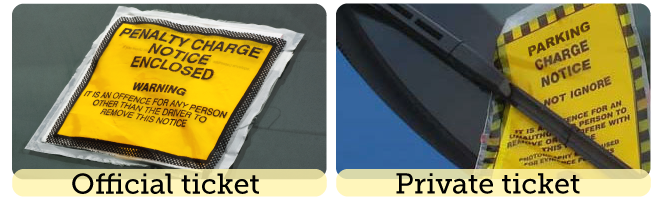
These photos of an official 'PENALTY Charge Notice' and a private 'PARKING Charge Notice' show just how similar they can be. Yet the private ticket is NOT a fine – it's just an invoice.
And while you may get a ticket slapped on your windscreen, the growing use of automatic number-plate recognition cameras and CCTV systems to monitor parking means you may not receive a physical ticket, and instead get a parking charge sent through the post. This guide covers both scenarios.
If you've got an official parking fine – known as a Penalty Charge Notice, Excess Charge Notice or Fixed Penalty Notice – see our Parking ticket appeals guide instead.
But if it's a private parking 'fine', aka a Parking Charge Notice (PCN), do read on.
2. This is all about fighting UNFAIR tickets

Of course, landowners have a right to charge for and manage parking – for example, you may have blocked a hospital entrance. So, if you think the rules were fair, were displayed prominently, and it's a fair cop, you should really shrug and pay up.
However, this guide is to prevent you from being out of pocket when most reasonable people would think a ticket is unfair. The most important thing if you're in this boat is…
DON'T JUST PAY AUTOMATICALLY
Reclaiming afterwards is tough – it's far better to dispute the ticket first. Challenge it using the steps below.
Do bear in mind, though, that if you think the charge is just too high, disputing a ticket on these grounds is now more difficult than it was.
3. Here's why a parking ticket might be unfair
There are various reasons a parking ticket may be unfair, but some of the main ones include:
-
You didn't break any rules – for example, you were charged while trying to pay. If you didn't do what the ticket claims, then it's been wrongly issued.
You might have been penalised for taking too long to pay, for instance – some drivers have for taking more than five minutes. However, a recent rule change now gives you more leniency over how long you have to do this. -
There was no or insufficient signage. The basis for the ticket is that you'd agreed to what the notice stated. But having one sign at a car park's entrance isn't enough. That's because you could argue that when manoeuvring, you need to be concentrating on driving, not reading parking signs. Signs need to be visible from all over the car park to be sufficient. Provide photos of the signs to use as evidence.
-
You weren't on private land. Staggeringly, this can happen. If you weren't on private land (say, you were on a public road or in a council car park), then refuse to pay the ticket. Again, take pictures as evidence.
-
There were mitigating circumstances. The parking trade bodies' single code of practice features an appeals charter which outlines various mitigating circumstances considered for appealing against a ticket.
These include attending to an emergency or your car breaking down. See the single code of practice for more info.
4. Don't think of private parking tickets as 'fines'
Private parking companies have no official right to fine you, though they may try to make you think that they do. All they're doing is sending you a notice of what they deem to be a breach of contract.
Park in a private car park and you're entering into an unspoken contract with the landowner. They're letting you park, while you're agreeing to meet their conditions. Under UK contract law, if you break those conditions, they can argue you broke the contract.
Yet that doesn't mean they can issue tickets willy-nilly, without just cause – and ultimately to enforce its case a firm would need to take you to court. No one wants that. But even if they do, it isn't a criminal issue, just a contract dispute.
Industry change is coming with Government to introduce new code of practice
The Government is currently working on a new code of practice which will be set out in law, in an effort to improve standards in the private parking industry and make it harder for firms to unfairly charge motorists.
It launched a public consultation in summer 2025 to gather information from across the industry before it begins work on this new legislation-backed code of practice, which will include guidance on fair practices and appeals.
(The parking trade bodies the British Parking Association and International Parking Community had brought in a voluntary code of practice in February 2025, but this arguably does little to address the issues affecting the industry.)
Until the new statutory code of practice is put in place, however, you're best off challenging these unfair tickets by following the steps outlined below.
5. Don't assume the driver is liable – it can be the vehicle's keeper

It might be the driver wot dunnit – but that doesn't mean it's the driver who'll have to pay.
That's because, in some circumstances, parking firms can hold a vehicle's keeper – the person named on its V5C registration document – liable for unpaid charges.
It's the Protection of Freedoms Act 2012 that gives parking operators this power in England and Wales, but to be able to use it, they have to meet certain conditions. If they don't, they can't hold the keeper responsible.
Bear in mind too that you're under no legal obligation to tell a private parking operator who was driving the vehicle. Therefore, in circumstances where it can't hold the keeper liable, not naming the driver can be a powerful move, as it can make it much harder for the firm to build a case against you. So don't name the driver.
Not all private parking firms will be able to find out your address
Only accredited private parking firms can get the registered keeper's details from the Driver and Vehicle Licensing Agency (DVLA) to chase them for an unpaid parking charge. To be accredited, a company must be a member of the British Parking Association or the International Parking Community.
That's why it's important to check whether your ticket's from an accredited firm. If you think a non-accredited parking firm has got hold of your details unlawfully, tell the DVLA.
The rules are different in Scotland and Northern Ireland
There's currently no 'keeper liability' in Scotland and Northern Ireland. This means that, for now, registered keepers of vehicles can't be held responsible for charges, if they refuse or are unable to say who was driving at the time.
In Scotland, the law allows for 'keeper liability', as part of the Transport (Scotland) Act 2019, but it's not been fully implemented yet.
However, British Parking Association and International Parking Community members CAN still get registered keeper details from the DVLA in Scotland and Northern Ireland, and can ultimately pursue any unpaid parking charges via their equivalent of the county courts. But as the law currently stands, parking charges can only be recovered from the driver.
If you get a ticket in these countries but weren't the driver, you can simply state that, as the keeper, you're not liable for any costs, you aren't prepared to state who was driving and you're under no obligation to do so. It's best to do this in writing so you have a record. We've a template message to help if needed.
If you're ticketed in a hire car anywhere in the UK, you'll still be responsible for the charge
That's if you've accepted liability for this under your hire agreement. The car hire firm can name you as the hirer (and then you can appeal against or pay the charge). See hire-car parking charges below.
6. You may be exempt from paying for NHS parking – for example, if you have a blue badge

It's also possible to challenge unfair tickets issued by private parking firms at NHS hospitals and other locations by using the steps in this guide.
Do bear in mind that there are also a number of free parking allowances for hospital patients and workers. In some of these cases, you may need to apply for a permit.
You're exempt from paying for parking at NHS sites if:
You're a blue badge holder and a patient, visitor or employee of the hospital trust.
You're an outpatient who attends hospital appointments at least three times a month.
You're a night-shift hospital worker starting after 7.30pm and ending before 8am.
You're the parent or guardian of a child under 18 who is staying at hospital overnight. You're able to park up to two vehicles for free from 7.30pm to 8am.
Details of charges should be well publicised at around car parks and inside hospitals. NHS trusts should also publish this info on their websites and on patient letters and forms, where possible, as well as details about complaint procedures.
As we say in our step-by-step help below, after gathering any evidence, do contact the landowner as a priority – in this case, the NHS – to see whether you can get the unfair ticket cancelled.
Discuss private parking in our forum. The parking board in the MSE Forum has a wealth of information on the industry and is somewhere you can raise issues or seek help. Also, feel free to give us feedback there on this updated version of the guide.
How to challenge an unfair private parking ticket
We hope that you'll be successful if you challenge your unfair private parking ticket using the steps below, but obviously can't guarantee it, so ultimately it has to be your call to see whether it's worth it.
Fortunately, sometimes it's possible to get a ticket cancelled almost right away – let's explain how.
Try our new AI-powered Private Parking Ticket Checker tool
We've developed a new tool to help you to challenge an unfair private parking ticket. MoneySavingExpert's Private Parking Ticket Checker is still in testing mode, but we'd love you to try it out and give us your feedback.
The tool understands much of this guide and uses AI tech, which means you can chat to it about your specific private parking case, to get guidance on fighting your unfair ticket. You can also:
Show it relevant documents. Upload photos from the scene, such as misleading signs, any copies of actual Parking Charge Notices, and letters you may have got.
Get a drafted personalised appeal letter. The Private Parking Ticket Checker can take your specific info, plus any documents you upload, and turn it into an appeal letter for you.
See where you are in the challenge process. The tool will know where you are in the step-by-step process, and be able to guide you accordingly.
We care about your privacy, so anything you say or show to the tool will disappear once you're finished – we won't store any of your info. Do give it a try and feed back via the tool itself.
Step 1. Gather evidence
First off, collect as much evidence as you can, whether you're still at the scene or not. The aim is to reflect the situation when you got your ticket as closely as possible, so it may be that you need to swiftly return to the car park to gather evidence, as this can be the key to a successful challenge.
Here's what to collect (if possible):
Photos. Snap any unclear signs, bay markings or lines, and areas where you believe they should be. Also take pics of where your car was, the meter and your ticket, plus anything else that might be relevant.
Correspondence. Keep everything you've received from the company and copies of any information you have sent.
Proof of mitigating circumstances. Keep anything relevant, such as receipts from a recovery company if your car was broken down.
Witness statements. If anyone will corroborate your story, get their details and ask them to sign a statement – for instance, if it was impossible to see the signs or you were loading or unloading goods and stayed within the rules.
Step 2. See whether the landowner will cancel the ticket

You may be able to get your unfair private parking ticket cancelled almost straightaway – by complaining directly to the landowner.
Take the evidence you've collected to it, and it may be willing to intervene on your behalf – particularly if it's a big company with a reputation to protect.
For inspiration, here's a list of cases where motorists have had parking tickets cancelled simply by complaining to the landowner or retailer. This helpful record was compiled by MSE Forumites, who have plenty of experience in fighting unfair tickets.
Plus, legitimate complaints should make parking companies think twice about their conduct, as they don't want people complaining to their clients. Notifying landowners of their sub-contracted parking firms behaving unfairly may also make them reconsider renewing contracts with these companies too.
Who exactly you should contact depends on the car park:
Supermarkets. Chat to supermarket management directly.
Retailers or retail parks. Contact the retailer, or, if it's a shared car park, the retail park managing agent – its name almost always appears online or on the welcome sign at the entrance.
Hospitals. For NHS hospitals, complain to the Patient Advice and Liaison Service. Find the relevant service by typing in the hospital's postcode on this page. Although, remember – you may be exempt from an NHS parking charge. For private hospitals, chat to management directly.
GP practices. Complain to the practice manager.
Residential car parks. Talk to the managing agent or the housing association.
If you're unsure who owns the land, check any signage around the car park or ask retailers on the site who they pay rent to (or whether there's a managing agent). If you still don't get anywhere, contact the local authority and ask who pays the car park's non-domestic/business rate. As a last resort, get the Land Registry to search the index map for you – do note that this comes with a £4 fee.
Step 3. Check whether your ticket is from a trade-body-registered parking firm
Now check whether your ticket is from a firm that's a British Parking Association or International Parking Community member. These are the UK's two private-car-parking trade bodies.
Do this by going to the trade bodies' websites, as both list all of their registered members:
If the firm IS trade-body-registered
If the parking firm is on either of the BPA's or IPC's membership lists, move on to step 4.
If the firm ISN'T trade-body-registered
You have three options in this case:
-
a) Tell it you're not willing to pay the unfair ticket. But know that in doing so, this will give the firm your contact details and ultimately could end up with you at the small claims court. So be prepared for this.
-
b) Use the company's own appeals process. However, we DON'T recommend this, because, if the firm has actively chosen not to join a trade body, then there is no regulation of its appeals process, calling into question how fairly you'll be treated there.
-
c) Ignore the ticket. If the parking company isn't on either the BPA's or IPC's membership lists, it almost certainly isn't a member and therefore can't apply to the DVLA to get your details.
Some parking campaigners suggest that you simply shouldn't respond to the parking company in question, to stop it getting your contact details. Without your address, the firm won't be able to track you down anyway, so the idea is you won't ever have to pay the ticket.
However, it's important to note that this is a controversial strategy and one we're highlighting simply as something that some individuals choose to do. If you're considering this route, it's essential to understand the potential risks involved, including the possibility of legal action if the company does get your details.
Again, non-BPA and non-IPC registered firms CAN'T legally get your address details from the DVLA. If one of these companies has got hold of your details unlawfully, report it to the DVLA.
Step 4. If your ticket is from a trade-body-registered parking firm, dispute it directly
If the private parking firm is a member of the British Parking Association or International Parking Community, and you can't get the landowner to cancel your ticket, the next step is to dispute it directly with the company itself.
To do so, use the firm's official appeals process and explain why you don't agree with the unfair charge. Take a screenshot of your complaint for recordkeeping purposes. You may be able to send a letter, but appealing online, if you can, means it's much easier to keep track of what you've said.
Our free template message
We've created a helpful template letter you can use as a basis for your appeal.
Dear Sir or Madam,
Re: Parking Charge Notice number [insert Parking Charge Notice number]
I dispute your 'parking charge', as the keeper of the vehicle. I deny any liability or contractual agreement, and there will be no admission as to who was driving and no assumptions can be drawn.
Since your Parking Charge Notice is a vague template, I require an explanation of the allegation and your evidence. You must include a close-up photograph of the sign you contend was at the location on the material date, as well as your images of the vehicle.
If the allegation concerns a payment machine, the data supplied in response to this appeal must include the record of payments made – showing a partial vehicle registration number – and an explanation of the reason for the Parking Charge Notice, because your notice does not explain it.
If the allegation involves an alleged overstay of minutes, your evidence must include the actual grace period agreed by the landowner.
[Insert your name and address]
DON'T name the driver
At no point do you have to tell the parking firm who was driving the vehicle at the time that the ticket was given. You're under no legal obligation to do so.
By avoiding naming the driver from the start, you could make it much harder for the firm to build a case against you. This is especially true if you were ticketed at an airport, port or railway station.
However, bear in mind that in some circumstances, the parking firm can hold a vehicle's keeper – the person named on its V5C registration document – liable for a parking charge, if it doesn't know who was driving.
To be able to do this, the parking company must meet specific conditions set out in law, such as using the correct wording in its 'Notice to Keeper' and sticking to a certain 'keeper liability' timeline.
If it doesn't meet these requirements, the company can't hold the keeper liable for a ticket, and it won't be able to hold the driver responsible, either, if it doesn't know who was driving. So don't name the driver.
Check whether the firm's 'Notice to Keeper' is incorrect
A mistake on the company's 'Notice to Keeper' can give you extra ammunition as you make your appeal.
You'll receive a 'Notice to Keeper' (NTK) in the post if the following applies:
-
You're the car's registered keeper, AND
-
You were caught on camera (and didn't get a ticket on your windscreen), OR
-
There was a ticket on your windscreen and you didn't respond, or someone else was driving and didn't tell you about the ticket
There are specific rules around how NTKs should be sent and written and sometimes a parking firm gets these wrong. If it has, it's often possible to appeal on a technicality, so check the wording of the company’s NTK carefully, and highlight any issues in your appeal.
(Our knowledge of this route comes from MSE Forum members who have a great deal of experience in fighting unfair parking tickets. They've also helpfully compiled a thread of photos of real 'Notices to Keeper'.)
What to watch for on the Notice to Keeper
Here's a list of what should be included on a Notice to Keeper. If any of these details aren't on it, do flag this as you appeal to the firm. NTKs must:
-
Specify the vehicle, where it was parked and when.
-
Tell the keeper that the driver has a parking charge and that it hasn't been paid in full.
-
If a parking ticket was given at the time, the NTK must repeat that info – if it wasn't, it should say that the keeper is being charged and what they have been asked to pay.
-
Say how much remains unpaid.
-
Say that the firm doesn't know the driver's details and invite the keeper to pay or tell it the driver's details.
-
Warn that if payment hasn't been made within 28 days (from the day after a correct NTK was given) it will have the right to recover the missing amount from the keeper.
-
Include details of any discount for prompt payment and processes for solving disputes.
-
Say who is demanding payment and how they should be paid.
-
State the date on which the NTK was sent or given.
Check when you received the Notice to Keeper
If the parking firm doesn't meet certain deadlines around its Notice to Keeper (NTK), highlight this as an error when you make your appeal.
(Missing these cut-offs also means that it won't be able to hold the keeper liable, and therefore not naming the driver becomes a useful tactic in helping you to beat a parking charge.)
The deadlines differ depending on whether you got a ticket placed on your car (Notice to Driver), or whether you got a Notice to Keeper sent through the post:
-
If a ticket WAS initially given on your windscreen, you must be given 28 days starting the day after the alleged incident to pay the ticket or to appeal, and if you don't, the firm then has another 28 days following the original 28 to follow up with an NTK.
-
If a ticket WASN'T initially given on your windscreen, a Notice to Keeper must be served – in other words, received – within 14 days of the alleged parking incident.
Where NTKs are delivered after the 14-day window, the firm only has a right to take action against the driver. Again, you're not under any obligation to reveal who this was.
As long as you don't imply who was driving, you can highlight any flaws in the NTK in your appeal to the firm, stating that it did not comply with the NTK rules set out in the Protection of Freedoms Act and that you won't be paying the ticket.
Quick questions
Can I argue the charge is too much?
This used to be one of the main grounds for disputing a ticket, but doing so has become much more difficult since the Supreme Court's 2015 judgment on 'excessive' charges.
Judges ruled in the Barry Beavis case that £85 was not excessive for a 56-minute overstay and that parking charges are a "useful" deterrent. They didn't specify what would constitute an excessive charge, however.
I was in a hire car or one I'm leasing – is the guidance the same?
If you got an unfair private parking ticket in a hire or lease car, you can appeal as normal, by following the steps outlined in this guide.
Crucially, you can appeal as the 'hirer', and you don't need to say who was driving.
If the ticket was put on the car, appeal against it within two weeks. This will make life easier as it will stop the parking company from getting the keeper's (the hire or lease firm's) details from the DVLA.
If the hire or lease firm gets a Notice to Keeper in the post, and names you as the hirer, as above, you can appeal.
In this scenario, you should then receive a 'Notice to Hirer' from the parking firm. Check for a frequent error on this: by law, the company must include a copy of the hire agreement and the original Notice to Keeper in its Notice to Hirer. However, often firms don't do this, so do check, and flag this as an error when you appeal to potentially beat the charge at this stage.
I'm in Scotland/Northern Ireland, so is the guidance different?
Like in England, you should first appeal to the landowner. If that doesn't help, then send this template message to the firm in question.
If it then gets to the next stage – appealing via the official trade body – the current guidance from parking campaigners is simply... not to bother.
This is because, as it stands, keepers in Scotland and Northern Ireland (or those who have been ticketed there) CAN'T appeal to Popla (Parking on Private Land Appeals).
However, this is likely to change in the new statutory rules in 2026, in part because it's a fundamental right that keepers are entitled to appeal a notice. For now, though, the guidance is to skip this stage.
If you do, be aware that the firm may continue to pursue you for the supposed debt.
What do I do if get a Parking Charge Notice at an airport, port or railway station?
Private tickets issued in these places are subject to different rules than regular private parking tickets, as the Protection of Freedoms Act 2012 does not apply. As a result, parking firms giving tickets at airports, ports and railway stations cannot rely on keepers having strict liability (meaning that they can't hold a keeper responsible, regardless of who was driving).
For this reason, some parking campaigners suggest you simply need to appeal against any Notice to Keeper you may get in these places, WITHOUT naming the driver. If you're not the keeper, for example, because it's a hire or lease car, you must respond yourself to the ticket quickly – see what to do if you were in a hire car.
In rare cases, you may get a 'Penalty Notice' at a railway station car park, rather than a Parking Charge Notice (PCN). With Penalty Notices, train companies have six months to bring a claim (rather than the six years, or five in Scotland, that parking firms have with standard PCNs). Therefore, in this scenario, some campaigners suggest that if you don't name the driver, and the train company doesn't pursue the matter in court within six months, the charge may essentially expire, and you won't be liable to pay it. There is little incentive for the firm to start a court claim if it doesn't know who was driving.
You may start to receive debt collection letters in the meantime, but these don't really carry any legal weight unless court proceedings are initiated, as we explain below.
Step 5. Appeal through the relevant appeals service

If you don't get anywhere with your parking operator appeal, the next step is an independent appeal. It's worth understanding though, that by entering into this process, you're accepting the legitimacy of the appeals system (which is run by the parking industry).
There are two trade bodies and each has its own appeals process:
Parking on Private Land Appeals (Popla) – for British Parking Association members. You can appeal online (the preferred option) or via post to Popla, PO Box 1270, Warrington, WA4 9RL.
The Independent Appeals Service (IAS) – for International Parking Community members. You can appeal online, or by post or email.
Bear in mind that MSE Forumites have reported that it's extremely difficult to win an IAS case, so consider this when deciding whether or not to take this step. It may only be worth it if you have a strong case with compelling evidence, which you're confident you can win.
If you do decide to skip an IAS appeal, you may start getting debt collection notices, and you should prepare yourself to be taken to court.
How to appeal at the second stage
How to appeal to Popla
Write a detailed appeal. If you're using the online service, you have to attach it as a PDF and send along with any relevant photos (such as a photo of the car park sign).
Like before, do not say who was driving. If you haven't ever received a Notice to Keeper, make this very clear, as this will significantly strengthen your appeal.
What should I do if the firm contests?
If the parking firm contests the appeal, it will put forward an 'evidence pack', which will be sent to you. You then have seven days to comment on the company's evidence, something that can help you with your case.
Look through the evidence and find specific points that you can highlight to back up your argument, such as signs being unclear or illegible.
Your comments need to disprove the parking company's case. Don't simply rewrite your appeal or call it 'an appeal', or Popla may not read it – this is about highlighting the flaws within the firm's evidence.
Next, a Popla assessor will make a decision based on the submissions from you and the parking firm, and will send it to both parties at the same time (you'll receive an email notifying you a decision has been made).
What happens if I lose at Popla?
We discuss what to do next in more detail below, but to summarise briefly: losing at Popla DOESN'T mean you have to pay the charge (these decisions have no legal force), even though it will tell you to. If you do lose, you will most likely face one of the two following scenarios:
-
Unless it's a particularly litigious parking firm, you will likely just get a series of debt collection letters, or maybe letters from the parking company itself. See our guidance below about ignoring the debt notices – there's no need to panic here.
-
You might have to defend a small claim – full info on how to do so below.
How to appeal to the IAS
As stated earlier, MSE Forumites have found it hard to win appeals via the IAS. So do think about whether you want to take the time to appeal in this way. If you have a particularly strong case that you're 100% confident you'll win, you may want to try. Visit the IAS website or post your appeal to get started.
What happens if I lose at the IAS?
Like if you lose a Popla case, you WON'T have to pay the parking charge, even if you're told to (the IAS has no legal power to make you do so). You'll likely start receiving debt collection letters and/or a notice that you're being taken to court. The same is true if you don't bother with the IAS stage at all. We have full tips on what to do next below.
Step 6. Fight a court claim

The final stage of fighting an unfair parking ticket is in court. While it might not get to this point, you should be prepared for this step in the process, which will take up time and energy.
It's free to defend a claim and if you win, you won't have to pay the parking charge or the costs.
But, be aware that if you lose your case in court, you WILL have to pay the parking charge. You'll also have to pay the court fees if ordered to do so (which, on a single Parking Charge Notice claim, are currently a £35 claim filing fee, £50 capped legal fees, a £27 hearing fee and, potentially, other expenses such as interest).
Typically, MSE Forumites report on our forum's parking board that judges don't allow the industry's controversial 'debt recovery fee', so most claims that include this sum are generally reduced by £70 with the typical final cost (if a case is lost) being not much higher than the £170 often demanded by the debt collectors. Our Forumites report that most cases that involve them continue to be won by defendants or discontinued (dropped before hearings).
If the parking firm does want to proceed with a small claim against you, it'll send you a 'letter before claim', giving you notice that it's planning to take you to court to try to recover what it believes it's owed.
Dealing with a 'letter before claim'
A 'letter before claim' (aka a 'letter before action' or a 'letter of claim') is a formal letter putting you on notice that court proceedings may be brought against you. You have 30 days to send the parking firm a response.
Reply to a 'letter before claim' using the template below. Clearly state your reasons for disputing the claim, and include any evidence you intend to use later in court, such as photos or proof of a blue badge. Make sure to use a traceable method when responding (for example, recorded delivery or email with read receipt), so you have proof of sending.
You may also receive letters from debt collectors
Debt collection agencies may start – or already have started – to send you letters regarding the parking charge, on behalf of the parking firm.
Don't panic here: debt collection firms aren't bailiffs and they CANNOT take your goods. If you're willing to continue fighting the unfair ticket after the official appeal stage, and you're prepared to be taken to court, you can ignore letters from these debt collectors. Don't write back to them, don't email, and certainly don't call them. DO NOT IGNORE any letters from the court (such as a claim form) – as failing to respond to these could result in a default judgment against you.
However, do reply to the debt collectors if you've moved home recently and there's a chance they may now have two addresses for you. This may be the case if, for example, you've recently moved and not updated your address with the DVLA. The firms having two addresses for you can result in you missing key correspondences (including official court documents), which can have serious consequences.
Contact the debt company and parking firm and tell them to delete your old address and to only use your new one. Do this if you move again within six years of the Parking Charge Notice (within five years in Scotland), as the 'statute of limitations' for contract debts is six years (five in Scotland), meaning after this time you can no longer be chased for the debt.
Quick question
What if I've got a letter from ParkingEye?
If you get a letter direct from ParkingEye (not from DCBLegal on its behalf) instead email ParkingEye's litigation team to resolve the dispute: enforcement@parkingeye.co.uk. Treat the ParkingEye email as your last gasp chance to appeal. Alternatively, it'll accept you naming the driver and postal address, and should reissue the Parking Charge Notice and start again with the driver being allowed to appeal.
Our free template message
To whom it may concern,
Your ref: [insert reference number]
Proposed legal proceedings
Claimant: [insert name of parking company]
I refer to your letter of claim.
I confirm that my address for service for the time being is as follows, and any older address must be erased from your records:
[Insert correct address here]
I dispute the alleged debt, for the following reasons:
[Insert reasons]
[If you want to include evidence, add the following sentence]
Please also see attached evidence which proves that the parking charge was issued unfairly.
[Attach evidence, for example, photos]
As above, the alleged debt is disputed and any court proceedings will be vigorously defended.
Yours faithfully,
[Insert your name here]
Dealing with a court claim
If your reply to the letter-before-claim doesn't get your Parking Charge Notice cancelled, you'll now likely receive a court claim. Even at this stage, some cases may not make it to a hearing, but it's useful for you to be aware of the next steps:
-
Firstly, acknowledge you've received the claim for money via the Money Claim Online service. You MUST do so within 14 days, or the claimant can apply to the court for a judgment in default; in other words, the firm will automatically succeed with its claim.
-
You'll then need to write a defence and send it to the Civil National Business Centre (CNBC), which deals with money claims. Use the Money Claim Online (MCOL) system via your Government Gateway account (don't forget to hit the 'submit' button), or you can email or post it.
However, the latest advice from MSE Forumites is not to use email or post, because the CNBC sometimes loses defences. Put it in using MCOL if you can, but be aware there is a limited character count. Include as much info as you can, including points of fact and any laws that you intend to rely on. -
The parking firm could withdraw the claim at this stage, though it's unlikely. The CNBC will send you a 'DQ N180 form', which you must complete and return to the claimant (in other words, parking firm) and the court.
-
The case file will then be transferred to your local county court, and you'll eventually receive a notice of allocation, giving you a date and time for the hearing. It will also specify a deadline for you to submit a witness statement, and any other documents you intend to rely on – usually 14 days before the hearing, but sometimes earlier than that.
Your witness statement can expand on your defence statement and should include any evidence to back up your case, such as photos of unclear signage, for example. -
Be sure to attach a costs assessment (just an A4 page) if you are taking a day's leave from work, have specifically incurred other costs, or have had to pay for childcare or travel to the hearing. Bring proof of costs, such as receipts and wage slips, to your court hearing, should it get to this.
If the parking firm doesn't give up by this point, you'll need to mediate with it ahead of a court hearing...
Quick questions
How does mediation work?
Since May 2024, mediation sessions are mandatory for money dispute cases under £10,000. This means both parties must attend an appointment to try to resolve their case ahead of a court hearing. These are usually over the phone, always free of charge, and there's no pressure to settle the case if an agreement can't be reached.
Positively, a number of MSE Forumites have found mediation to be beneficial, with reports of parking firms essentially giving up and agreeing to settle for £0 at this stage. Clearly, there's no guarantee of this happening in your case, but this does illustrate the potential benefit of continuing to hold your ground.
What should I do on the day of the hearing?
If mediation fails, you'll have to fight the claim in court. Get there half an hour early to go through security and sign in with the usher. Once in, don't discuss anything with anyone from the other side, if they attempt to talk to you – wait until the case is officially heard in the court room.
During the hearing itself, be confident but respectful. Take a crib sheet with bullet points to help you focus, plus printed versions of both sets of witness statements and evidence, so you can follow what is said.
Once all the evidence is heard, the judge will make their decision.
-
If you win, you've successfully challenged the parking ticket. Well done! You now won't have to pay the parking charge or any court costs. You'll also be able to ask that the parking firm pays your costs (although bear in mind that this is at the judge's discretion and is not guaranteed).
-
If you lose, you WILL have to pay the parking charge. Plus, you'll have to pay the court fees, and, potentially, other expenses too (see details of court fees above).
If you don't respond to the claim and don't pay the money that you owe, you could end up with a county court judgment (CCJ) against you. A CCJ is a court order that requires you to pay back a debt, and it can play havoc with your ability to access credit.
You won't get one for simply losing a court case – CCJs are for when you fail to respond to the claim for money. This could be because you've actively ignored the court claim or it was sent to the wrong address – learn how to avoid this below.
A CCJ lasts for six years and will appear on your credit record during that time, likely negatively affecting your rating as well as your ability to borrow.
What should I do if I get a county court judgment (CCJ)?
If you pay a CCJ within 30 days, it wipes it. However, don't just automatically pay it – it may be possible in some circumstances to get the judgment 'set aside', meaning it's cancelled (see the next quick question).
How do I get a CCJ set aside?
You may be able to get the CCJ set aside – in other words, cancelled – if it was wrongly issued after you'd already paid off the debt, or if you didn't receive the original claim from the court saying that you owed the money.
To do so, you'll need to complete an 'N244 application notice', then go to a private hearing at the court to explain why you don't owe the money.
You may have to pay a £313 fee to do this.
Important: Always update your address with the DVLA
It's crucial to remember to update the address on your vehicle log book (V5C). This Gov.uk guide tells you how.
If your details aren't up to date and a parking firm sends you a letter-before-claim, it could go to your old address. In this scenario you wouldn't see it, potentially resulting in a CCJ and the company getting money from you, plus all the other negative impacts of this type of court judgment.
By updating your address with the DVLA, you stop this happening.
I can't afford the fine – what should I do?
Decided to give in or been unsuccessful with your challenge? Paying the fine may prove particularly tricky if you're struggling with your finances and/or in debt.
In this scenario, we recommend seeking out support – our full step-by-step Debt help guide is an ideal place to start.
Share this guide?