



Moving overseas with a pension in the UK – what you need to know

If you’re thinking of leaving or returning to the UK, what happens to your State Pension and any private pensions you have is likely to be an important consideration. Making a wrong move with your pension when moving abroad or coming back to the UK can be costly. So we've got some things you'll need to consider about Qualifying Recognised Overseas Pension Scheme (QROPS), tax implications, transfer charges and more.
What happens to my State Pension if I move overseas?

The full new State Pension is currently £230.25 a week (for 2025/26), though this depends on how many qualifying years you've built up – there's more on how it works in our State Pension guide.
When you're in the UK, your State Pension entitlement increases each year in line with the 'triple lock', which is designed to ensure it doesn't lose value over time.
You can still claim your UK State Pension if you move overseas, though if you’re entitled to a top-up through Pension Credit this entitlement will stop if you move abroad permanently.
Whether you'll get the annual increases to your State Pension amount will depend on where you move to:
Move to another country in the European Economic Area (EEA), Gibraltar or Switzerland: and you’ll typically still receive these annual increases to your State Pension.
Move to a country that has a social security agreement with the UK: and you'll also get the increase each year, this includes Jamaica, the Philippines, Turkey and the USA.
Move elsewhere: and your pension may be frozen at the rate you first receive it, without annual increases. Common countries where your UK State Pension will be frozen includes Australia, Canada, New Zealand, South Africa, India (and many more). This means over time, your State Pension will lose value in real terms.
You don't have to start taking your State Pension as soon as you reach State Pension age, you can defer it giving you a higher amount when you do claim it. See Should I defer taking my State Pension guide for more.
How do I claim the state pension if I move abroad?
You’ll need to contact the International Pension Centre (IPC) to move your State Pension abroad, and complete an International Claim Form.
The government can pay your State Pension into:
-
A bank account in the country you live in (this will be paid in local currency, so exchange rate variations and currency conversion fee could affect the amount you receive); or
-
A bank or building society account back in the UK.
If you only spend part of the year abroad, you’ll have to decide which country you want to be paid in as you can’t get part of your State Pension in one country and part of it in another.
Although any Pension Credit you're entitled to will stop if you move abroad, if you're abroad temporarily to receive medical treatment, you may still be able to receive Pension Credit for up to 26 weeks – and it can be claimed again if you return to the UK. There's more information about this on the gov.uk website.
Can I continue to build National Insurance years from abroad?
If you retire abroad before you reach State Pension age, unfortunately living and working abroad typically does not count towards NI years, so you won’t accumulate entitlement to your UK State Pension during that time.
Remember, to get the full State Pension, you need at least 35 qualifying National Insurance (NI) years. You can currently keep building up NI years while living abroad by making voluntary Class 2 or Class 3 NI contributions depending on your circumstances (eg employed/self-employed abroad, or not working).
However, from April 2026 you'll no longer be able to make voluntary Class 2 NI contributions to buy qualifying years for a UK State Pension.
You won't lose any NI years you had accrued before you left, so if you return to the UK you can pick up where you left off, or you may be able to buy some National Insurance years.
What happens to my UK workplace or private pension if I move overseas?
If you've got a UK workplace or private pension, and you move abroad (either permanently or temporarily) the pension is still yours. It remains invested, under your name, and managed by your pension provider.
However, moving overseas can have tax implications when you start taking money from your pension (you can do this from age 55, increasing to 57 from 6 April 2028).
If you become resident in a country outside the UK, that country might tax your UK income. However, if there’s a double-taxation agreement, you can usually ask HMRC to apply relief on the UK tax – so you'd only pay tax in your country of residence under its rules (and avoid being taxed twice).
BUT if the country you've moved to doesn't have a tax agreement in place, you could end up paying tax on your pension in the UK as well as where you're now living.
The Government's Tax on your UK income if you live abroad lists the countries the UK has double-taxation agreements with, with details of how to claim tax relief.
If you have permanently moved abroad your UK bank may insist you close your account. You may need an international account - these often have minimum balance requirements and higher charges than UK current accounts.
Can I transfer my UK pension to a new country?
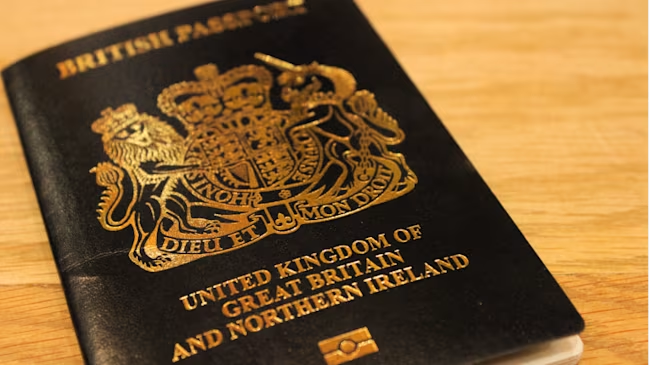
Moving a UK pension overseas is complex and there's a lot to consider. Importantly, if you decide you want to move a pension, you'll need to be careful you do it in the right way to ensure your money is safeguarded. Always seek independent financial advice before making any moves.
If you transfer your UK pension overseas it will then be regulated by the country the scheme is based in – the pension income will be paid in local currency and you'll be taxed by the country you've moved to, so make sure you know the rules around this.
Look for a recognised scheme
A Qualifying Recognised Overseas Pension Scheme (QROPS) is an overseas pension scheme that meets HMRC conditions and can receive approved transfers from UK pensions. It means its regulated in the country it’s based in, broadly meets UK pension rules, and reports to HMRC.
Your UK pension provider should not allow a transfer to another pension that is not either a UK registered pension scheme or a QROPS.
Deciding whether a QROPS transfer is right for you
If you're thinking of transferring your UK pension overseas, there are two main things to first consider:
-
Does the country have a QROPS you can transfer a UK pension to? HMRC maintains an official list of recognised QROPS so you can check.
However, the list has shrunk significantly in recent years, and now some popular destinations might not have many (or any) QROPS available. If that's the case, you might be better leaving your pension in the UK. -
How long will you be in the new country for? If you might only be going for a few years and then may move again - leaving your pension in the UK may be wise. That's because you'll only qualify for a tax-free Overseas Pension Transfer – avoiding a 25% Overseas Transfer Charge (OTC) – if the following apply:
- You live in the same country where the QROPS is based, and remain there for at least five full UK tax years after the transfer, or
- Your employer is providing the QROPS and they’re sponsoring your move.
Avoiding the OTC can be complex, so it's good to seek expert advice on the transfer. You can see the information needed for an overseas pension transfer on GOV.UK.
QROPS can have high set up and annual fees, so make sure you check these and factor them in to your decision, as it could be more costly than keeping your pension in the UK. However, this isn’t always the case and needs to be balanced with currency risk and the fact you're likely to pay higher banking charges in the UK as a non-resident.
If the transfer is above the available OTA a 25% tax charge will apply
If you want to avoid the tax charge, the total amount you’re transferring must also be within the overseas transfer allowance (OTA) which is currently £1,073,100 for most. Your OTA might be higher if you applied for protection before 6 April 2025.
The 25% charge applies only to the amount over the OTA, not to the full transfer, so for example, if your OTA is £1,073,100 and you transfer £1.2m, the 25% charge applies only to the £126,900 excess.
So it's important to check the size of your pension against your OTA before considering an overseas transfer.
No QROPS in your new country? You might be better leaving your pension in the UK
If you're moving to a country without a QROPS, you might be better keeping your pension in the UK where it remains heavily regulated and offers safeguards – such as Financial Services Compensation Scheme (FSCS) protection and oversight by the Financial Conduct Authority (FCA) and The Pensions Regulator.
As well as this, you can continue to benefit from any options your existing pensions might have, which could include flexible drawdown options, wide investment choice, access to the 25% tax-free lump sum (though be aware that local taxation abroad may apply to the lump sum), and you can leave funds invested in GBP and convert only when you need to, giving you control over currency timing. For more on how to take your pension see the Guide to taking your pension.
Having said all this, there are some instances where it may make sense to move your pension abroad, for example if:
-
You live in a country with a well-regulated QROPS market (eg Malta, Australia - note you need to be 55 to transfer to most Australian QROPS).
-
Your long-term plans are certain (eg permanent retirement abroad).
If you do decide you want to do a transfer, you might be required to seek regulated advice before you can move it (often for 'final salary' (defined-benefit) schemes with a transfer value of £30,000 or above). However, when it comes to transferring any pension overseas, it's probably a good idea to seek independent financial advice anyway to make sure you don't get stung.
Here's a side-by-side analysis for if you're on the fence of what the best option is for you...
Leave Pension in the UK | Transfer to a QROPS | |
|---|---|---|
Regulation & protection | Strong UK regulation (FCA, The Pensions Regulator, FSCS protection) | Depends on country – some less regulated, weaker protections |
Costs | Generally lower ongoing fees - but may have higher banking fees if your provider will only pay to UK bank account | Often high setup + annual fees (can be £1k–£3k+ a year) |
Tax at transfer | No tax just for keeping pension in UK | Generally 25% Overseas Transfer Charge unless you live in same country as QROPS |
Investment options | Wide choice (esp. in Self-Invested Personal Pensions) | Varies; some QROPS have limited or costly investment ranges |
Currency | You'll be subject to local currency fluctuations and possible currency conversion charges | Can hold in local currency (removes poor exchange rate risk if retiring abroad long-term) |
25% tax-free lump sum | Available in UK (but may be taxed in country of residence) | Rules differ; some countries won’t recognise UK’s 25% exemption and some countries offer more |
Double Tax Treaties (DTA) | UK has many DTAs – often avoids double tax | DTAs can apply too, but taxation depends on local rules |
Inheritance Tax (IHT) | UK pensions usually outside IHT, but pensions in estate from April 2027 can still be caught by IHT for up to 10 years after you leave the UK | Some QROPS can reduce UK IHT exposure if structured right |
Can I transfer a pension to the UK from overseas?

As your pension is at risk here, it's always best to seek and pay for independent financial advice, they'll be able to help you check whether you'll face any tax issues and are meeting the regulatory requirements in the UK.
Exchange rate and currency conversion fees can eat into any amount transferred affecting the value of your pension. Transfer fees - including admin fees, exit fees from the overseas scheme, and set up fees to the UK scheme - also need to be taken into consideration along with any exit taxes or restriction the overseas country may apply.
If you've sought expert advice, considered the monetary impact and decided to go ahead, to transfer an overseas pension into a UK pension scheme, you'll need to consider:
The UK scheme must accept overseas transfers – not all UK pension providers will accept them
The overseas scheme must allow transfers out – some foreign schemes restrict transfers
It's important to keep in communication with both your overseas account you are transferring from and your new UK pension provider to make sure the funds leave and arrive as they should do.
Need more help with a pension transfer abroad?
As we've already said, due to the risks associated with transferring your pension abroad, if this is what you decide to do, before you make any moves it's definitely a good idea to pay for independent financial advice.
They'll be able to talk you through how potentially you may be worse off by transferring your pension abroad, explain all the tax implications, and help find an overseas QROPS-registered pension provider.
As well as paid-for advice, there's also some free guidance you might want to take advantage of:
-
MoneyHelper offers free and impartial guidance on transferring your pension abroad, spotting scams, and related tax matters and has a find a retirement adviser tool you can use to find someone to help.
-
The International Pension Centre (IPC) can advise on your State Pension eligibility and claiming process overseas.
-
Pension Wise (via MoneyHelper/Citizens Advice Service) provides free guidance for those aged 50+ with defined contribution pensions.
Share this guide?