





How should I take my pension?
When and how is the right way to take money in your private or workplace scheme

Pensions can be complicated and your money needs to last you throughout retirement. If you've got workplace or private pensions, taking the money at the right time and in the right way will be important, and getting it wrong can be costly. This guide gives you an overview of what you need to consider when thinking about how to access your money – and where to go for free guidance.

First, a quick overview of taking your pension
You can access a Money Purchase (defined-contribution) pension at 55 (rising to 57 from 2028) – but that’s just the minimum age. If you’re still working or don’t need the money, leaving it where it is could mean you have more later.
Plan for the long-term – pensions may need to last 20 or 30+ years. Think about your health, any other sources of income (state pension, work, property, inheritance), and how much you're likely to need to cover your essentials and other spending.
The 25% tax-free rule – you can take up to a quarter of your pension tax-free. The rest will be taxed as income, so withdrawing too much in one go can push you into a higher tax band.
You have different options for how and when you access your pension – and they have different levels of flexibility, risk and tax implications. Which will suit you will depend on your priorities.
You can get FREE guidance – so you don't need to make the important decision about how and when to take your pension on your own.
Prefer to listen? Martin discusses pensions
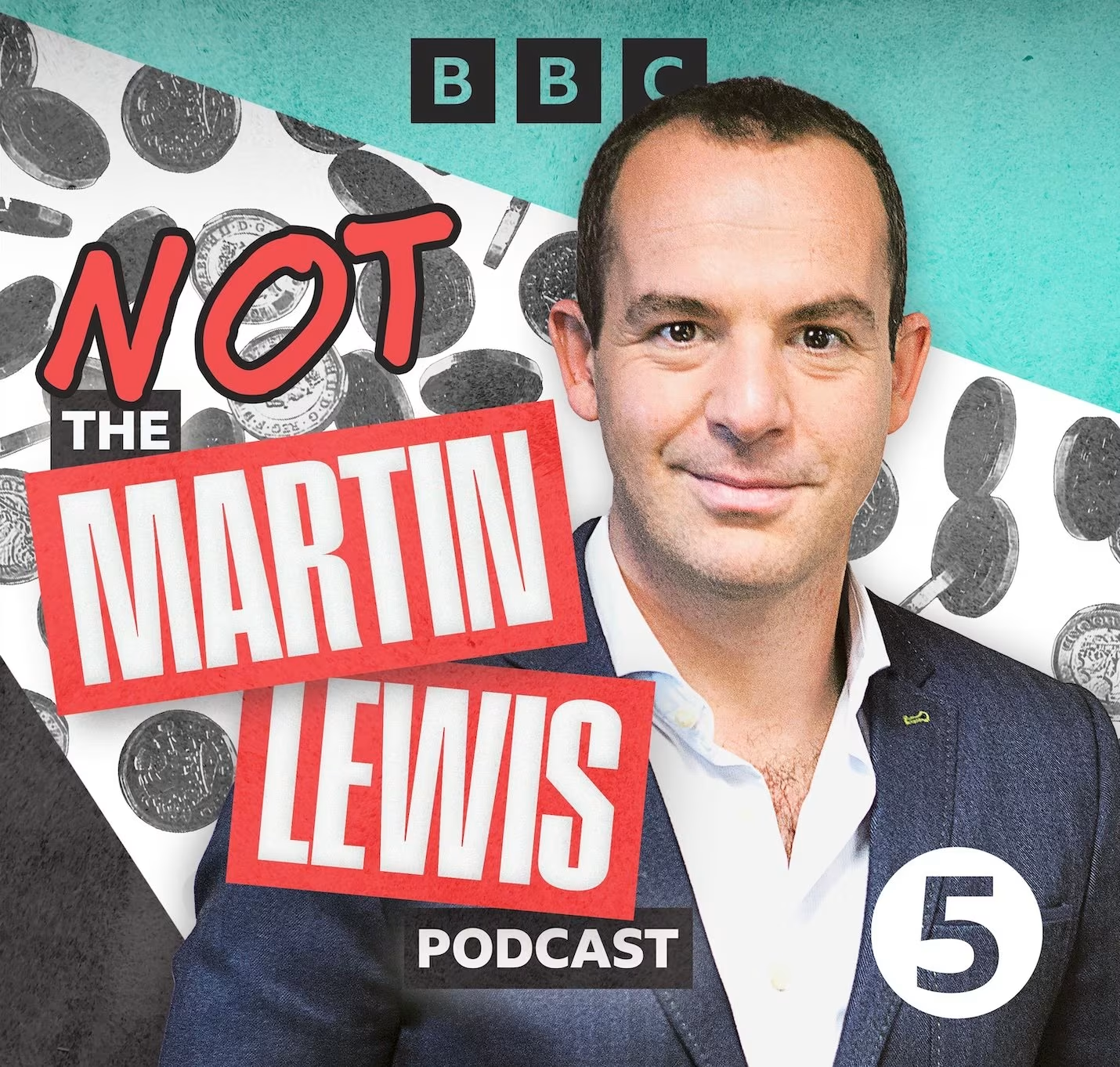
In his spin-off BBC Not The Martin Lewis Podcast, Martin takes on subjects with the help of specialists. Here, he looks at how to get money from your pensions...
Listen to 'How to take money from your pension' (July 2024) for free via...
BBC Sounds | Apple | Spotify
When is the right time to take my Money Purchase pension?

Most modern workplace and all private pensions are Money Purchase pensions (also referred to as 'defined-contribution' pensions).
In a Money Purchase pension, you build up a 'pot' of money through your own contributions (as well as any your employer adds). You can access this pot from the age of 55 (rising to 57 on 6 April 2028) – but just because you can legally access the money, it doesn't necessarily mean you should.
As Money Purchase pensions are the type you'll have to make decisions about how and when to access your money, they're the focus of this guide. Other types of pensions don't work in the same way – such as Final Salary scheme (defined-benefit) pensions and the State Pension. If you're not sure about the differences, see our types of pensions explainer.
Deciding how and when to take your pension money is a balancing act – it's unlikely you'll want to run out too early by splurging too much. But equally, living frugally when you’ve saved money to enjoy, might not appeal either.
The good news is you don't need to work through the options on your own. You can get free guidance, with appointments available for those aged 50 and over (or those who inherit a pension or retire early due to ill health problems).
This guide will give you an overview of the things to think about to help you prepare. First off, it's worth thinking about some key questions:
Four key questions to ask yourself...
-
Will I still be working at age 55? Realistically a lot of us will still be working at age 55 (or 57 when the rules change). So if you're still working and earning, think about whether you need that pension money now. You might be better keeping it where it is, especially if you and your employer are still adding to it, so it'll continue to grow for when you may need it more.
-
How long will I live? It might sound strange, but it's worth thinking about so you don't underestimate how long your money might have to last. A 65-year-old man will, on average, live for another 20 years; a woman will, on average, live another 22 years. But there's also a 10% chance of a man living to 96 and a 10% chance of a woman living to 98.
Health and genetics affect lifespan, but your current age is the single most important factor. The Government has a basic tool, the Life expectancy calculator, as a starting point. -
What other income will I have coming in? The money in your pension pot might not be your only source of income in retirement. Have a think about when and how much you'll be getting in State Pension and any other benefits you might be entitled to.
You may decide to continue working into retirement, have money from rental properties, downsize on your own property, or be due some inheritance. Take some time to consider what this might look like for you. -
What will my outgoings be? Knowing what you’ve got coming in is only one side of the see-saw. To be able to work out how much income you need, you’ll have to look at your likely continued outgoings too, such as any mortgage repayments or rent, food, gas and electricity, travel costs, insurance policies and more.
Your outgoings are likely to change as you get older – for example, you might have paid off your mortgage, but could be facing more in care costs as you age. Plans to spend money travelling in the earlier retirement years could tail off as you get older. If you’ve time it’s worth going through a proper budget to see how it all stacks up – which will hopefully try to future proof when you do take your money. For help with this we have a Budget Planner.
How you take your pension will affect the tax you pay
When you do decide to take your pension, you're allowed to take 25% of your pension as a tax-free lump sum.
You could simply withdraw the rest as cash if you wanted to, but you'd have to pay income tax on it at your 'marginal rate'. So if you're a basic-rate taxpayer, you'd pay 20%; a higher-rate taxpayer would pay 40%.
That means take out too much in one year, and it could push you into a higher tax band – so it's important to plan how you get the money out.
If you have multiple pension pots you can take 25% from each. There are different ways you can manage this, and it’s important to get this right, which is why free pension guidance is so important.
The maximum tax-free cash most people can take in their lifetime is currently £268,275. This is called the Lump Sum Allowance (LSA) and it applies across all your pensions.
Prefer to watch? Martin Lewis explains why how you take the tax-free part of your pension is important...


(Courtesy of ITV's 'The Martin Lewis Money Show'. You can turn on subtitles by using the closed captions icon at the bottom of the video.)
When it comes to the tax-free element, it can help to think of your pension as a jam roll: the jam is the tax-free part (25%) and the sponge is the taxable part (75%).

You can take SLICES of the roll
You withdraw smaller chunks over time. Each slice you take contains 25% jam (tax-free) and 75% sponge (taxable) in the same tax year you take it.
You keep the rest of your roll invested, to grow (or shrink) until you need more.
Tax implications: Because the taxable sponge is counted alongside all your other income for that year, taking a big slice could push you into a higher tax band.

Or you can take ALL the jam at once
You take your full 25% tax-free lump sum in one go. The remaining pension pot sponge is moved into drawdown or used to buy an annuity.
You’ll then pay tax on that sponge only when you withdraw some of it or get income from it in future.
Tax implications: This can be smart if you expect to be in a lower tax band later – for example, after you stop working.
Taking taxable income from your pension will reduce how much you can put in
As long as you haven't taken any taxable income from a pension, each year you can put in up to £60,000 or the total of your taxable earnings, whichever is lower. This is known as your 'annual allowance'.
However, once you take any taxable income from a Money Purchase pension, the maximum amount you can pay in each year reduces to £10,000. This is known as the Money Purchase Annual Allowance (MPAA).
So if you're still earning and contributing to a pension, and don't need to start taking the money, you could be better off leaving it where it is.
There is an exception worth mentioning: you can usually take up to three personal pension pots of £10,000 or less in full without triggering the MPAA (25% tax-free; 75% taxed as income). This can be useful for smaller pots – but always get guidance first.
Remember, however, that you can still only make personal contributions (including tax relief) up to the same value as your taxable UK earned income.
The five main options for taking a pension
Here's an overview of the five main options of how you can take your pension, as well as what it could mean for any tax you'll have to pay.
Remember to make use of the free pension guidance available to help you decide the best option for your savings.
1. Use a pension drawdown arrangement
Drawdown is effectively an investment product. When you invest your pension money pot into a drawdown product you'll be buying a mix of investments with the aim of getting a regular, taxable income in return to fund your retirement (though as with all investments, what you'll get isn't guaranteed).
-
You can take a tax-free lump sum of up to 25% in one go, and invest the remaining amount (75% or more) into drawdown to generate an income.
-
You can take income as you need it. It's possible to take a regular income, a bit like getting a monthly salary, or take income as and when you need to. Or you can leave it invested if you don’t need to withdraw income.
-
You can also withdraw money in a way that is tax efficient. Once your money's in drawdown, any money you take out will be considered alongside any other income received in that tax year. Making large withdrawals could push you up income tax band.
Therefore, taking the tax-free cash all in one lump and putting the rest into a drawdown product could be a useful option if you’re likely to earn less income as you get older, and therefore be in a lower-tax band.
As this is an investment product there is of course an element of risk – your hope is it will grow, but there is a chance it will shrink. Then again you took the same risk when the cash was in your pension, as that is an investment too. If you do this, you should be comfortable with the concepts of investing and making regular checks that it is performing well and comfortable monitoring it when you're in your twilight years.
This option is often attractive for anyone wanting to pass on any pension savings when they die, for more on this see the Inheriting a pension guide.
2. Use your pension savings to buy an annuity
You can use some or all of your pension pot to buy an annuity. An annuity provides you with a regular guaranteed income in retirement.
-
You can take a tax-free lump sum of up to 25% in one go, and use the rest (75% or more) to buy an annuity. Annuity income will be taxed like any other income.
-
An annuity will give you a guaranteed income each year for the rest of your life – this security is a great strength of this option for many people. An annuity could give you less of an income than you'd get with the investment returns of a drawdown product, but it can’t ‘run out’ if you live a long time.
-
You can't generally pass on an annuity (unlike money in a drawdown product). So when you die, your annuity will end (unless it's a joint-life one).
If you do decide on an annuity, don’t just plump for your pension provider’s one – rates vary widely so ensure you get the markets best by shopping around (and look for ‘enhanced’ annuities if you’ve had health issues).
3. Take lump sums leaving the rest invested until you need it
The official name for doing this is taking uncrystallised funds pension lump sums (UFPLS). In non-jargon, it just means you are using your pension a bit like a savings account.
-
Here you DON'T take the 25% tax-free lump sum in one go, but instead take ‘slices’ of money as and when you need it – with the bulk of your money remaining invested in your pension.
-
When you do take cash, 25% of each amount is tax-free and the rest is taxed as income - using the jam roll analogy - you're taking a slice. For example, if you take out £10,000, £2,500 of it is tax-free and £7,500 is taxed as income.
Although this option gives you flexibility on how you access your pension, it does have tax implications. How much tax you pay on the taxable 75% portion will depend on your total amount of income. Withdraw too much in a year and it could push you up a tax band.
4. Withdraw all the money in one go
If you have a small pension pot that won't give you much in the way of a regular income, you might think about taking all out in one go – especially if the money could be useful, for example to pay off existing debts that are costing you money.
While it's possible – and with smaller pots of under £30,000 you might not even need financial advice – you need to be careful. It could easily push you up an income tax band, which could be costly.
This is because most people can earn £12,570 income without paying tax (known as the personal allowance), then you pay 20% tax on everything up to £50,270 and 40% tax on everything above that (Scotland tax bands are slightly different, but the principle is the same) .
So although the first 25% will be tax-free, the remaining 75% is taxed as income at your usual rate.
5. Mixing the options to best suit your needs
You can mix your options at different times after the age of 55. For example, you can take some cash from your pot first and buy an annuity later.
So for example if your pension pot was £100,000:
-
You could take 25% as tax-free cash, which is £25,000
-
Use £20,000 to buy an annuity. This would give you a taxable income for the rest of your life of about £900 a year
-
Put the remaining £55,000 into a drawdown product and take the money the investments make as income.
You don’t have to decide to combine straight away, you could take your 25% tax-free lump sum if you want to pay off your mortgage, for example. You could put the rest into a drawdown product, but then if you decide you want a more guaranteed income, you could buy an annuity later on in your retirement with your drawdown money – though it will depend on what your provider offers.
Is it better to go into drawdown or buy an annuity?
For many who want income, the choice is about whether to use pension money to buy an annuity, or to put your money into an investment drawdown.
After a decline in popularity, annuity rates have improved in recent years, presenting them as a viable option for those who want the security of knowing how much income they are going to have for the rest of their life.
But with that security there are some drawbacks, such as often not being able to pass on an annuity when you die, so which one is better for you will depend on a number of factors. And remember to ALWAYS seek guidance before you do anything.
Drawdown | Annuity | |
|---|---|---|
How flexible is it? | You choose where your pension is invested and are responsible for it. You can withdraw money when you want. | Once your annuity is set up, your income is fixed for life and can't be changed. It doesn’t need to be reviewed and won't run out. |
Is my money safe? | While your fund remains invested, it is not guaranteed and is subject to the ups and downs of the market, so your income could fall. | Your income is secure, and isn't affected by market performance. |
Can I run out of money? | Yes, it's possible to run out of money. This is because the amount of income you receive depends on how well your investments perform and how much you withdraw. | No. The idea of an annuity is that you don't run out of money in retirement as it's a guaranteed income for life. |
What return will I get? | This will depend on investment performance. | Your income will depend on the annuity rate. Always look for the best annuity rate before you take one out. |
What happens when I die? | If you die your funds may be inherited by your dependants as a taxed lump sum, via income drawdown, or as an annuity. | Once it has been set up, your annuity can't be altered. It can't be inherited by your dependants unless you selected a spouse’s income or a guarantee period when the annuity was set up. |
Can my personal circumstances get me a better deal? | Income drawdown doesn't take health or lifestyle into account, as it’s based on investment return. | If you smoke, suffer from any ill health or currently take any prescribed medication, you could enhance your annuity income significantly. |
Get FREE guidance before you pay for financial advice

Deciding how to turn your pension pot into an income for the rest of your life is one of the most important decisions you'll make.
Getting free guidance or advice is crucial – get it wrong and it can cost you.
Aged 50 or over? Go to Pension Wise
MoneyHelper's service Pension Wise is backed by the Government and offers free, impartial guidance. To get an appointment you must:
be aged 50 or over and have a UK-based Money Purchase (defined contribution) pension pot/s (this could be a personal or workplace pension), or
have inherited a pension pot, or are able to take your pension early due to ill health, if you are under 50.
It's a good idea to be a bit prepared before your appointment to get the most out of it, for example, making sure you know what sort of pensions you have and their value. For more info, see the Pension Wise website on how to prepare.
Appointments last for about an hour and afterwards you will get a document summarising your pension options, including your next steps, personalised information based on your situation and details of where to get further support.
Under 50?
As explained above, you need to be 50 or over to get a Pension Wise appointment. That's because normal minimum pension age is currently 55 and the Pension Wise appointment is about the different ways you can take money out of a pension. You can only have an appointment before age 50 if you're in ill health or inheriting a pension.
You can still however get any guidance you might need if you don't meet the criteria by using its chat function or calling the helpline on 0800 011 3787, or use the MoneyHelper site for more info.
Complex pension arrangements or high-value pensions? You might be best with financial advice
The free options above will give you guidance and explain your options, but they will not give you product recommendations or work out a detailed plan for your money. For that, you'd need independent financial advice, which is a regulated industry and you'll need to pay for it.
However, if you have complicated pension arrangements or larger amounts of pension savings, seeking advice from an independent financial adviser (IFA) is often a very good plan. You can ask the adviser for bespoke advice and someone to pick products and create a financial plan for retirement.
Normally they’ll open the account for you and select the investments, so this also takes away some of the hassle if you’re unsure how to do it yourself. And even though you'll have to pay for their services, it could mean you avoid making costly mistakes by trying to go it alone.
Different financial advisers will have different charging structures. For more on this and the services they can provide, see our Financial advice guide.
Taking your pension FAQs
How much money is in my pension?
Unless you keep on top of the pension statements that land on your doorstep, it can be difficult to know how much money you have stashed in your pension. The wake-up pack you receive from your pension provider as your approach your 50th birthday should help.
If this doesn’t help you can look at your pension statement – your provider should send you this once a year. If you can’t find that you can contact your pension provider(s) if you know which it is – or if it was an employer pension you could try contacting your old employer to see if it has any details.
If you paid into more than one pension pot, then you’ll need to contact each pension provider to find out the value of each pension.
What do I do if I can't remember who my pension provider is?
If you’ve had a few pensions over the years possibly with various employers, then it can be easy to lose track of who your different pension providers are. If the company that you worked for still exists, you could try calling the HR department if it has one and ask it if it knows who the pension provider is.
Worst case scenario, if you think you’ve completely lost track of a pension you had, contact the Pension Tracing Service on 0345 600 2537 or visit Gov.uk. This is a database with over 200,000 workplace and personal pension schemes.
Do consider however whether or not you have actually lost your pension. That’s because, even if you have a certificate from a pension scheme, it doesn’t always mean that you have a pension entitlement.
For example, you might have had a refund of your contributions when you left that employer. Also, many older pension schemes may have required a certain number of years of membership from you, before giving you any benefits. See the Finding old pensions guide for more information.
Will the amount I withdraw affect any benefits I get?
If you get a means-tested benefit such as Jobseeker’s Allowance or Pension Credit, then pension income can reduce that. If you get a lump sum, then this may count towards your savings total – if you’ve over £6,000 of savings it can reduce your benefit, and over £16,000 it can stop it.
In fact, once you reach state pension age, 66 for both men and women, you may lose some benefits even if you don’t take your pension, because it counts as ‘notional income’. For more help on pensions and benefits, speak to Citizens Advice and use the 10-minute benefits checkup.
I have been called by a company that says I can invest my pension with it and get massive returns, should I go with it?
No is the simple answer! Often it’s almost certainly what is known as a ‘pension liberation’ scheme. These are set up by fraudsters and place your pension money in unregulated investment schemes.
They will be targeting the over-55s in the knowledge that some people may be confused about exactly what they can do with their pension. But they offer no protection if, but more likely when, you lose your money. It is effectively the equivalent to handing your pension money to a bloke down your local pub.
Can I change my defined benefit pension into a defined contribution one?
Yes you can. In fact, to take advantage of the various options explained in this guide you would need to transfer your final salary pension into a money purchase one. However, think very hard before turning down the benefits of a final salary pension.
That’s because if you have a final salary pension, the income you’ll receive from this can be very valuable. What you’ll get is calculated from your salary in the final year of employment. Your employer will typically take 1/60 of your final salary and multiply it by the number of years you have been in the pension scheme.
An example may help: If your final salary is £80,000, then 1/60 of that is £1,333. If you’ve been with your employer for 25 years, times that by 25 and you’d be set for a pension of £33,325 a year. It’s a requirement that you get financial advice before taking this step if the value of your pension benefits is more than £30,000, so financial advisers will be able to explain the potential benefits to you of keeping your final salary pension over trading it in for a money purchase pension.
This guide is about taking money from 'Money Purchase' (defined-contribution) pensions. This is the most common type of workplace or private pension.
It doesn't apply to Salary Scheme (defined-benefit) pensions or the State pension. If you need something different, take a look at our other pensions guides:
Pension consolidation – the pros and cons of combining your savings
Pension need-to-knows – key points for retirement savings
State pension – how the state pension works.
Share this guide?