
Base rate held at 3.75% – here's what it means for you and when it might change
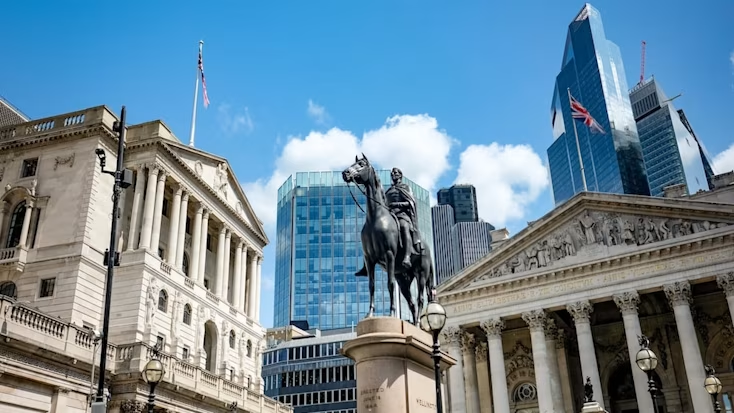

The Bank of England has once more held the base rate at 3.75%. We explain why, the latest predictions for when it might change, plus what it means for your mortgage and savings.
The base rate is used by the central bank to charge other banks and lenders when they borrow money – so it influences what borrowers pay and what savers earn.
It's also used by the Bank of England as a tool to control inflation (the rate at which prices rise). The Bank has a target – set by the Government – of 2% for the Consumer Prices Index (CPI) measure of inflation. The latest figures show that CPI inflation was 3.2% in the 12 months to January 2026 – down from December but still above the Bank's target.
Why the base rate was held
Today (Thursday 19 March), the Bank's Monetary Policy Committee (MPC), which determines the rate, voted unanimously to hold the base rate.
The MPC said "The Committee will continue to monitor closely the situation in the Middle East and its impact on global energy supply and energy prices. It stands ready to act as necessary to ensure that CPI inflation remains on track to meet the 2% target in the medium term."
Expected base rate cuts 'feel like a distant memory'
After last month's base rate hold, financial experts had predicted a cut in the coming months. But the conflict in the Middle East has introduced a level of uncertainty.
Danni Hewson, head of financial analysis at AJ Bell, said: "Although rate setters held the Bank of England's base rate at 3.75% in February, the minutes stated that it was 'likely to be reduced further'. This now feels like a distant memory... The escalating conflict in the Middle East has sent shockwaves through the global economy."
Aaron Strutt of mortgage broker Trinity Financial added: "Many people were hoping the base rate would be cut but this was always unlikely due to the ongoing uncertainty and worry about rising inflation. The UK economy's failed growth in January is a huge problem because even with the ongoing wars we need more positive economic activity."
Nicholas Mendes of broker John Charcol said: "The tone of the MPC minutes was firmer than many had been expecting. It is also worth bearing in mind that the meeting itself took place over the previous two days, so the decision to leave rates unchanged would have been made before the latest overnight strikes on Iranian and Qatari gas infrastructure.
"Markets are therefore reacting not just to the Bank's message, but also to a much more severe geopolitical backdrop than policymakers had fully considered when they voted."
The base rate will likely be volatile in the coming months
Mr Strutt continued: "The general long term direction for base rate still looks gradually downward, but the path is unlikely to be smooth especially with multiple wars and the ongoing uncertainty.
"The money markets are predicting the Bank of England is now expected to raise interest rates rather than cut them this year due to a surge in oil prices sparked by the ongoing hostilities between the US, Israel, and Iran."
Mr Mendes added: "If this proves to be a temporary spike and underlying inflation continues to soften, cuts later in the year are still possible. The domestic backdrop is not especially strong, and the Bank will not want to leave policy too restrictive for too long if growth and the labour market continue to weaken.
"If energy prices stay elevated for longer, or inflation expectations start to drift again, rates may stay higher for longer than markets were expecting at the start of the month."
Why inflation matters
The extract below is from our latest weekly email, published on on Tuesday 17 March 2026...
Inflation is a measure of price rises over the last year, and of course the first problem isn't inflation itself, but the price rises feeding it. The Middle East crisis means firms' input costs are likely to rise due to the price of oil and energy costs, and some of those rises will likely be passed on to us consumers in the coming months. So the severity and length of this conflict really matter financially in the UK.
The rate of inflation has other impacts too, including interest rates. The Bank of England is charged with keeping inflation low, at 2% CPI, and the main tool it has at its disposal is altering the UK base rate.
When inflation rises, the Bank of England is likely to want to cool demand, so there's less of a push to buy, and one route to do that would be to increase interest rates (making borrowing costlier and saving more attractive, to take money out of the economy). But that of course doesn't help economic growth.
Brokers say hopes of quick rate cuts have 'faded for now'
Mr Mendes said: "Recent market moves suggest a more cautious path is now being priced in. That helps explain why some lenders have already started to reprice and why hopes of quick rate cuts have faded for now.
"That does not automatically mean mortgage rates move sharply higher from here. It does, however, make near-term falls look less likely unless market sentiment improves and funding costs settle back down.
"For borrowers coming to the end of a fixed deal in the next three to six months, the safer approach remains to secure a rate early and keep it under review. That gives protection if pricing worsens, while still allowing time to switch to something better before completion if rates improve."
Mr Strutt added: "More borrowers will be tempted to take trackers as they wait and see what happens to fixes when the situation in the Middle East calms down. There has been more talk about the base rate having to go up to manage the threat of inflation. If this happens once or twice then tracker rates will suddenly look a lot less attractive."
Ben Thompson, director of home moving strategy at the Mortgage Advice Bureau said: "For homebuyers and current homeowners, the key message is not to panic. Focus on understanding your options rather than rushing into decisions, particularly in this fast-moving market."
My MORTGAGE fix ends in a few months, what do I do?
The information below has also been taken from our weekly email on Tuesday 17 March, though we've updated the latest rates as of today (Thursday 19 March)...
The Middle East crisis has made markets far less confident about seeing the UK base rate of interest being cut in the short term than they were. That has a real impact, as the rate at which you can get a new mortgage fix is based on swap rates, which, oversimplifying greatly, are based on the market's view of long-term interest rates.
So, as future rates are relatively higher, in the past couple of weeks we've seen the rate you can get a new mortgage fix at rise. At the start of the month, the cheapest fixes via our Mortgage best-buys were 3.55% (2yrs) and 3.77% (5yrs), now they're 4.14% and 4.24% respectively.
If your fix ends in the next six months, one option is to speak to your mortgage broker and current lender about locking in a fix now so you've bagged it in case things get worse. Yet ensure there is an option to ditch the locked-in rate before completion, if things have improved and cheaper deals are available.
See this almost like an insurance policy against things getting worse. With deals like this, you will sometimes need to pay a fee to leave the fix if things improve though, so check that out and decide if you think it's worth it.
Related: Cheap Mortgage Comparison | Remortgage guide | Ultimate Mortgage Calculator | Should I overpay my mortgage?
On your lender's SVR? You can likely save £1,000s with a new deal
A standard variable rate (SVR) is the rate you pay once your current mortgage deal comes to an end. SVRs have a variable rate of interest, which means the rate can change at any time.
SVRs are normally far more expensive than the best fixed or tracker deals – right now, a typical SVR is around 5% to 6.5%, while the top two- and five-year fixed rates start from about 4.14% and 4.24% respectively. So if you're on an SVR, you should consider switching to a new deal now – see our Cheap mortgage finding guide.
Some savings rates have risen slightly – but you can still find a good deal
Since the base rate was held at 3.75% in February, the top savings rates available on easy-access accounts have risen slightly, but it's still crucial to check your interest now. Millions are on pants rates, and can easily and simply move their money to where it pays more. If you're on a fix, diarise to act before it ends.
Currently, the top easy-access rate is a Cash ISA for newbies with Trading 212 at 4.68% variable. The next best rate is 4.5% from Chase, followed by 4.25% from DF Capital (£1,000+). If you prefer an established name and aren't eligible for the Chase deal, Coventry Building Society also pays 4.15%.
If you're worried about rates dropping and can lock money away, you might want to consider a fixed-rate account. Right now, you can lock in for a year at 4.36% with MBNA (part of Lloyds Banking Group) (£1,000+), or for two years at 4.33% with OakNorth Bank.
For full info and lots more options, see our Top savings accounts guide.


Share this guide?


 Latest weekly email












Clever ways to calculate your finances


