




Right to Buy mortgage scheme
Can you buy your council home at a discounted price?

Under the Right to Buy scheme, some council and housing association tenants are allowed to buy their home at a discounted price. This guide explains how the Right to Buy scheme works, who can take part and what size discount you can get.
This guide is for tenants in England and, to a lesser extent, Northern Ireland.
Who can use Right to Buy?
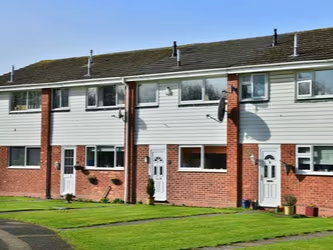
Right to Buy is a scheme in England that allows most council tenants, as well as some housing association tenants, to buy their rental home at a discounted price.
The scheme has been around for nearly 50 years, having first been introduced by Margaret Thatcher in the Housing Act 1980. Since then, more than two million tenants have used the Right to Buy scheme to become homeowners.
Right to Buy is also available in a more limited format in Northern Ireland (also known as 'House Sales Scheme). For more information, see the NIdirect website.
Right to Buy no longer exists in Scotland or Wales, having been abolished there in 2016 and 2019 respectively in order to maintain social housing numbers.
Right to Buy scheme eligibility
In England, you can apply to buy your council home at a discount if:
It's your only, or main, home. So you'll need to be living in the property.
The property is self-contained. In other words, you don't share any rooms – such as your kitchen, bathroom or toilet – with people outside your immediate household.
You're a secure tenant. So there's a legal contract between you and your landlord.
You've got a public sector landlord. For example, this could be a local council, housing association, NHS trust or the armed forces.
You've had a public sector landlord for at least three years. Though this doesn't have to be three years in a row and can have been across multiple homes.
You have no legal issues with debt. For example, a county court judgment.
If you don't want to buy alone, it's possible to make a joint Right to Buy application. This could be with someone you share your tenancy with, or with up to three family members who have lived with you for the past 12 months (even if they don't share your tenancy).
Do note that some types of property are exempt from the Right to Buy scheme. There's a Gov.uk document which explains the types of property that are exempt.
For more information on Right to Buy eligibility, see Gov.uk.
Can a family member buy my council home for me?

There are no strict rules around who is able to finance the purchase of a council home through Right to Buy.
This means a family member, for example, could help fund the purchase – possibly by contributing to your deposit.
However, legal ownership of the home must be in your name.
I live in an ex-council home. Can I apply for Right to Buy?
If your home used to be a council property but was sold to another public sector landlord while you were living in it, you may still qualify under 'Preserved Right to Buy'.
You may also be eligible for Preserved Right to Buy if, after your home was sold by the council to a new landlord, you moved into a different property owned by that same new landlord (though not if you moved into a property owned by a different landlord).
In both cases, you'll need to fulfil the normal eligibility criteria too.
Speak to your landlord if you think you may qualify under Preserved Right to Buy.
What is Right to Acquire?
If you don't qualify for Right to Buy or Preserved Right to Buy, there is another scheme called Right to Acquire. This scheme allows most housing association tenants to buy their home at a discount – though the discount is not as generous as Right to Buy's.
The eligibility criteria is similar: for example, you need to have had a public sector landlord for three years, and the property needs to be self-contained and your main/only home.
To be eligible, your property must either have been:
- Built or bought by a housing association after 31 March 1997, OR
- Transferred from a council to a housing association after 31 March 1997.
For more details about who qualifies for Right to Acquire, see Gov.uk.
Struggling with social housing disrepair?
We've got a guide on how to fix the likes of mould, damp and building repairs for free. See our Social housing disrepair guide.
How much is the Right to Buy discount?
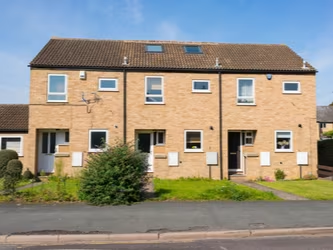
Where you qualify for Right to Buy, then you can get a discount off the market value of your council home.
The maximum discount you can get varies by region. Plus, the size also depends on whether you live in a house or flat and how long you've been a public sector tenant for.
Here's how it works:
Discount for council houses
Where you've been a public sector tenant for between three and five years. Here you'll get a 35% discount off the market value of your property, up to a maximum of your regional cap (details of regional caps in table below) – whichever is lower.
Where you've been a public sector tenant for more than five years. After five years, the discount goes up by one percentage point for every extra year you've been a public sector tenant, up to a maximum of 70% or your regional cap – whichever is lower.
Discount for council flats
Where you've been a public sector tenant for between three and five years. Here you'll get a 50% discount off the market value of your property, up to a maximum of your regional cap – whichever is lower.
Where you've been a public sector tenant for more than five years. After five years, the discount goes up by two percentage point for every extra year you've been a public sector tenant, up to a maximum of 70% or your regional cap – whichever is lower.
The table below sets out the maximum discount you can get by region:
PURCHASE PRICE | MAXIMUM DISCOUNT |
|---|---|
North East | £22,000 |
North West | £26,000 |
Yorkshire and the Humber | £24,000 |
East Midlands | £24,000 |
West Midlands | £26,000 |
Eastern | £34,000 (1) |
South East | £38,000 (2) |
South West | £30,000 |
London | £16,000 (3) |
(1) £16,000 in Watford. (2) £16,000 in Reading Borough; West Berkshire; Hart District; Oxford; Vale of White Horse; Tonbridge; Malling; Epsom; Ewell; Reigate; Banstead. (3) £38,000 in boroughs of Barking & Dagenham and Havering.
Where your landlord has spent money either building or maintaining your home, this could impact how much of a discount you're entitled to.
If you're buying in Northern Ireland, the biggest discount available is £24,000. For more info on how the discount there is calculated, see the NIdirect website.
Should I use Right to Buy?
If you're considering buying your council home then in some respects doing it through Right to Buy makes financial sense. As we've explained, those who qualify for Right to Buy can get a discount worth £10,000s off the market value – something not offered elsewhere.
Depending on the size of the Right to Buy discount, you may not even need to put down a deposit for a mortgage as the discount could effectively step in for the deposit.
However, there are a number of other costs and issues associated with being a homeowner that you don't have as a tenant which should form part of your decision:
-
Mortgage repayments. These will replace (and may be greater than) your rent.
-
Responsibility for repairs and maintenance to your home. This includes arranging and paying for it (the landlord will no longer be responsible for sorting this).
-
Buildings insurance. You'll likely need to arrange and pay for buildings insurance.
-
Service charges. If the property is leasehold – which most flats are – you'll likely have to pay a service charge to the council/housing association for maintenance of the wider building and surrounding area (read more about how leasehold properties work). You may already be paying this as a tenant, in which case nothing will change.
-
Your benefits entitlement may be impacted. Becoming a homeowner may mean you're no longer entitled to the likes of Universal Credit and Housing Benefit.
As there's a lot to consider, it's worth reading this Right to Buy summary booklet before deciding. And if you need further advice, see Gov.uk for where to can access it.
Support with utility bills and energy efficiency
If you buy your home then you'll become directly responsible for its energy and utility bills. The cost of this will be impacted by your home's energy efficiency.
Yet there is support available for those on low incomes and benefits with energy costs. Plus, there are also cash grants available to improve a home's energy efficiency.
So if you do become homeowner it's worth exploring Housing and energy grants.
Quick question:
Are there any reasons NOT to buy my council home?
There are some scenarios where it may not be worth buying your council home:
-
You expect to move home within a few years. As you may have to repay the Right to Buy discount. Furthermore, selling can be complicated.
-
Your income is unstable. As you may struggle with the mortgage.
-
The property needs major repairs. As these may be very expensive.
-
Large service charge bills are expected. Becoming homeowner may mean you need to shoulder a bigger burden of these than as a tenant.
None of these are reasons in their own right not to buy your council home, but they're all worth bearing in mind when coming to a decision.
How to use Right to Buy scheme – step-by-step

There are four steps involved when purchasing your council home through the Right to Buy scheme (though this doesn't include securing a mortgage, which we'll discuss below).
Here's what you need to do:
Step 1. Fill in an RTB1 application form. Follow this link to the form, which tells you all the information you'll need to include as part of the application form.
Step 2. Send the application form to your landlord. Once you've completed the online form, save, print and sign it. Then send the completed form to your landlord.
Step 3. Your landlord will say if they're willing to sell. Your landlord must respond within four weeks of your application (eight weeks if they've been your landlord for less than three years). Where the answer is no, the landlord should explain why. You'll only be able to appeal against a 'no' if the reason is that the property you want to buy is suitable for elderly people. To do this, you'd need to appeal to a tribunal.
Step 4. If your landlord agrees to sell, they will send you an offer. This offer must be sent within eight weeks of their agreeing to the sale if you're buying a freehold property, or 12 weeks if you're buying a leasehold. The offer will include details of:
- The price they think you should pay for the property and how it was worked out.
- Your level of discount and how it was worked out.
- A description of the property and any land included in the price.
- Estimates of any service charges for the first five years.
- Any known problems affecting the property's structure, such as subsidence.
Where you get an offer from your landlord, you'll have 12 weeks to tell them whether you want to buy the property. If you miss this deadline, your landlord will send you a reminder. You'll then have another 28 days to give your answer, or your application may be dropped.
If you change your mind at any point in the process, you can pull out of the sale.
What if I disagree with my landlord's offer?
If you believe your landlord has valued your home too high, you must write to them within three months of receiving the offer and ask for an independent valuation. A district valuer from HM Revenue & Customs (HMRC) will then visit your home and value it.
You'll then have 12 weeks to accept HMRC's valuation or pull out of the sale.

My landlord is delaying – what can I do?
Your landlord must respond to your application within the timeframes set out above. If they don't, you might be able to get a further reduction off the sale price of your home.
To get a reduction because of a delay, fill in the 'Initial notice of delay' form (RTB6) and send it to your landlord. Your landlord must then either move the sale along within one month or send you a 'counter notice'. The counter notice will say that the landlord has already replied, or explain why things can't be sped up.
If your landlord doesn't reply within a month of getting the RTB6, fill in the 'Operative notice of delay' form (RTB8). This means any rent you pay while waiting to hear from your landlord could be taken off the sale price. You can do this each time your landlord is late replying.
Don't forget you'll need to apply for a mortgage too
If you decide to buy your home, you'll be responsible for financing the purchase – in other words, applying for a mortgage (this isn't something your landlord can do for you).
For full instructions on how to bag yourself a competitive mortgage rate, either by using a broker or going direct to a lender, see our Cheap mortgage finding guide.
And if you're a first-time buyer then have a read of our full First-time buyers' guide.
Selling your Right to Buy home

You can sell your home after you've bought it through Right to Buy, but this does come with caveats. In other words, you can't buy your home at a big discount and then sell it off at full market value.
Plus, there are restrictions around who you can sell it to.
A social housing landlord may get first refusal
If you sell your home within 10 years of buying it through Right to Buy, you'll first have to offer it either to your old landlord or to another social landlord in the area.
Where the landlord wants to buy it, this should be at the full market price. If you can't agree on what this is, a district valuer will be appointed to determine the valuation.
Your landlord will have eight weeks to respond to the offer. If they don't get back to you, you can then sell your home to anyone after this time.
You must repay the discount if you sell within five years
If you sell your home after five years, you won't need to repay any of the discount you got through Right to Buy. But if you sell the property within five years, you will.
For example, if you sell within the first year of homeownership you'll need to repay all of the discount. After that, the total amount you'll need to pay back reduces to:
- 80% of the discount in year two of homeownership.
- 60% of the discount in year three of homeownership.
- 40% of the discount in year four of homeownership.
- 20% of the discount in year five of homeownership.
Importantly, the amount you repay also depends on the value of your home. So if your property has increased in value since you bought it, so does the amount you repay.
Let's say you bought your home through Right to Buy. It was valued at £100,000, but you got a 35% discount, meaning you paid £65,000 in total. You sell your home 18 months later, when it's valued at £120,000. As 35% of £120,000 is £42,000 and you've been the owner for two years, you'll repay 80% of £42,000 – which is £32,000.
You may not need to repay the discount if you transfer ownership of your home to a family member. But to do this you'll need the permission of your landlord first.
Looking for mortgage help?
We've got lots of other helpful guides and tools:
Cheap mortgage finding. How to find the top deal for you.
Mortgage Best Buys. Seek out top mortgage deals.
How much can I borrow Our guide gives an indication.
Shared ownership. An alternative homebuying scheme.
Joint tenants or tenants in common? How they differ.
Share this guide?