






When is the best time to renew car insurance?
Never auto-renew as you can save by timing your purchase

Most car insurance policies run for 12 months, with a new price calculated for the following year around a month before it ends. Yet you should never just auto-renew, as it's likely you'll pay more than you need to. You should always compare prices, and we've found that the best time to buy car insurance is 21 to 26 days ahead, as this is usually the cheapest. For why, read this short guide...

First, a quick overview of When is the best time to renew car insurance?
It pays to renew your car insurance at the right time. Here's what you need to know in brief:
A typical policy runs for 12 months. You'll get an automatic renewal notice about a month before the end.
NEVER auto-renew your car insurance. You'll likely pay more than you need to.
Renew car insurance 21 to 26 days ahead. Cover costs rise the closer to the renewal date.
Compare multiple policies before renewing. Our Compare+ tool takes the hard work out of doing so.
Let your insurer know if you're cancelling. You'll need to do so before the automatic renewal date.
How does the car insurance renewal process work?
A traditional car insurance premium runs for a period of 12 months, with the price you pay staying the same for the duration (unless any of your details change, such as getting a new car, moving home, having an accident or adding optional extras/changing your voluntary excess).

Around a month before your current policy end date, your car insurance provider will send you an automatic renewal notice which will have the price you paid for this year, and the price you'd need to pay for another year's cover with that insurer.
You can then choose whether to stick with it (do nothing and it will auto-renew and cover you for another year), switch to a different insurer or try to haggle for a better deal.
'My renewal quote doubled, but nothing's changed with me – why?'
We've heard this cry a lot over the last 12 months as insurers have been steadily putting prices up. The rise you've seen could be down to rising costs that insurers have to pay to get vehicles repaired or replaced (such as rising staff costs, more expensive parts). Or it may be that your insurer has changed its strategy and no longer wants to offer the best prices, or no longer wants customers with your risk and driving profile.
Of course, the above assumes that nothing's changed with your circumstances. If it has, then where you live, the car you drive, and any driving convictions or accidents (losing any no-claims bonus) can all change the price you're quoted – see what affects car insurance quotes.
Yet rather than comparing your new price to the one you paid last year, use a price comparison site to see quotes from multiple insurers at once, so you can work out where your renewal price sits. If all insurers are quoting a similar price, then it's likely that's just the new level you'll need to pay. But never assume this without checking, you could miss out on the best deal and saving £100s. Here's where you should start:
MSE's Compare+ Car Insurance tool

You could save £100s on your car insurance costs by switching car insurer. Our advice has always been to never just auto-renew – instead combine comparison sites to scour 100s of insurers and save money in minutes.
MSE's Compare+ Car Insurance tool is designed to take the hard work out of finding cheap car insurance online. You can...
Fill in just one questionnaire. We've borrowed MoneySupermarket's (so if you've used it before, your answers can be auto-filled).
Get MSE cost-cutting tips as you answer. Like our 'best time to buy' analysis tool, which tells you the likely cheapest time to get quotes.
See insurance quotes as a benchmark. These are from MoneySupermarket's comparison. But of course we want you to beat them...
Use personalised tips to cut costs further. These include whether you should add an additional driver, check multicar policies, or tweak your job title, often with one-click checks to see if it helps.
See whether other sites can further slice down costs. We give you our latest comparison site order of others to try, as MoneySupermarket may not be your cheapest. Plus, if you've time, we suggest you look at Direct Line, as it's not on most comparisons.
Alternatively, you can check our current list of which price comparison sites to try and in what order – full info in How to get cheap car insurance.
When's the best time to buy car insurance?
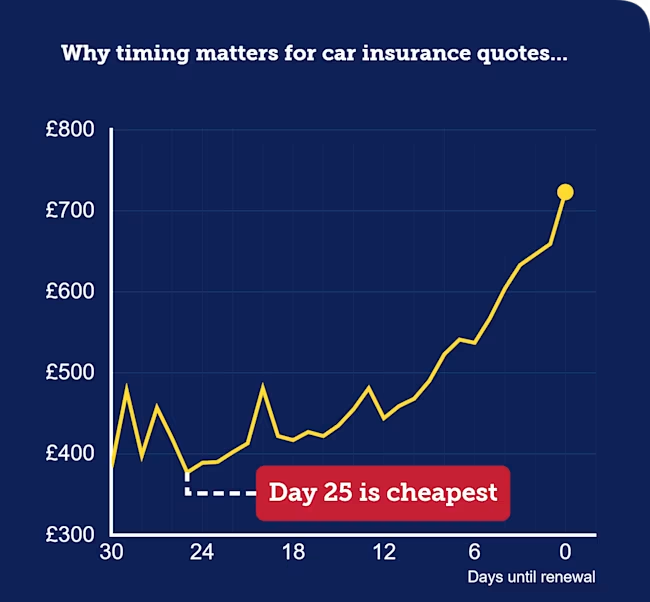
The cheapest time to get quotes is 21 to 26 days ahead of your renewal date – cover becomes more expensive the closer you get. It's the same if you are buying car insurance for the first time.
Strangely, the timing of your quote can impact the overall price you pay, with car insurance costs increasing the closer you get to your renewal date.
We analysed over one million quotes from MoneySupermarket between November 2025 and January 2026 – and found the cheapest time to buy is 21 to 26 days before renewal, with 25 days ahead the overall cheapest time. The average policy costs £723 a year on renewal day, but buy it 25 days earlier and this drops to £377 a year – a massive £346 saving. You might not see savings as large as those, but the principle still stands.
Why is it cheaper to renew my car insurance earlier?
When our best time to buy analysis concluded that insurance prices differed depending on how far in advance you got the policy, what insurers told us was generally the same thing – it's based around risk.
Buying insurance a few weeks before you need it suggests you're more careful and organised, while leaving it to the last minute means you're seen as higher risk. Some insurers have told us they've seen a direct link between drivers who leave sorting their insurance to the last moment and those who make a higher number of claims.
As for why the super-prepared are being penalised with higher prices for getting a quote 30 days in advance, it's basically because there are fewer insurers returning quotes at that stage.
Keep on top of your car insurance
Want to know when the cheapest time to get car insurance is? The MSE App has a new tool called Bill Buster – give us a few details about your insurance policy and we'll track it, alert you when it's ending and when you should start gathering quotes to save.


I've found a cheaper policy – how do I cancel my old insurance?
If you've found a cheaper or better policy elsewhere and want to leave your current insurer, you just need to let it know before the automatic renewal date, usually via phone or online chat.
The old insurer may ask you about the new policy and the price you've found, and will usually see if it can match it (or come close) to try and lure you to stay. If its counter-offer is decent and you choose to accept it, then your insurance will automatically renew at that new price. If you've already signed up to a new insurance company, just remember to cancel. You can usually do this with no cancellation fee within the first 14 days – this is known as a 'cooling-off period'.
If you still want to cancel, your insurer will process your request and you should receive confirmation that your cover will stop at 11.59pm the day before your renewal date. See car insurance cancellation for more help.
Want to learn more about insurance? Check out our guides on the topic:
Car insurance | Cheap van insurance | Caravan insurance | Motorbike insurance | Multicar insurance | Learner drivers' insurance | Gap insurance | New driver car insurance | No-claims discount | Breakdown cover | Black box insurance | Named driver insurance | Car warranties | Home insurance
Share this guide?