Search bar closed.
Use Cheap Energy Club to compare whole of market energy deals.
You'll get a unique bespoke prediction of what you'd pay if you stay on the Price Cap.

Should I fix my energy or stay on the Price Cap? Full help in 'Should you fix?'
Need help switching? Use our How to switch your energy guide.
Struggling to pay your energy bills? See what help is available.
On a price-capped tariff? See how much you'll pay from July. Use our Price Cap Calculator.
Average annual energy bills rose by an average of 13% on 1 July for those on standard price-capped tariffs (most households).
It's predicted the Price Cap will rise again from October, due to the ongoing conflict in the Middle East. You can check our guide for the latest predictions.
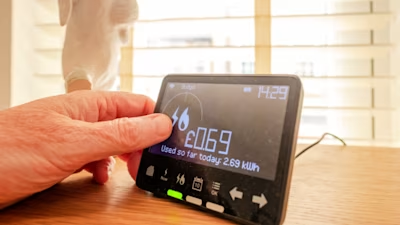
Since 2019, energy regulator Ofgem has capped the amount energy suppliers can charge for each unit of energy and the daily standing charge – but only for customers on standard and default tariffs (which most households are on).
Remember that it's the rates that are capped, so use more and you pay more.
Switching is easy, it's the same gas, same electricity and same safety. Only the customer service and who bills you changes. Your supply always stays on and no one visits your home unless you want or need smart meters.
To switch suppliers, follow these steps:
1. Enter your details – either directly with the supplier or you can register for our MSE Cheap Energy Club. You'll usually need your address, current energy supplier and usage, how you pay and whether you want to compare dual-fuel, gas or electricity-only tariffs.
2. Consider your options – make sure you compare all tariffs on the market to get the best deal and remember to factor in things like exit fees, tariff length and type.
3. Switch! (Or not) – if you've found a better deal, you can switch online or over the phone. The new supplier will handle the whole process so there's no need to tell your old supplier. Though remember to take a meter reading just before your switch completes.

Selecting a tariff can be confusing as there are a number to choose from that can be advantageous for different households. You can choose from...
Standard variable tariff – this is what most households are on and the rates you pay are set by Ofgem's Price Cap.
Fixed rate tariff – this offers a fixed price for each unit of energy and fixed standing charges for a certain length of time, so it protects you from rising prices, but you don't benefit when prices are falling.
Prepayment energy tariff – this means you pay for what you use and can be topped up online, over the phone or at local shops.
Economy 7 tariffs – this will take two readings, one for night time (off peak) usage, which is cheaper, and one for usage in the day (peak), which is more expensive. This helps encourage more night time usage, which is ideal if you have storage heaters.
Martin Lewis: The Middle East conflict will finally force its way onto most people’s energy bills from July, with a 13% rise in the Price Cap. The hit will be biggest for higher users, especially those who use gas.
Those on fixes won’t see a rise. And that means everyone on the Price Cap should get off it, if you can, and lock in a fixed rate below the current (April) Cap. Do that and you start saving straight away, and then from July the fix should be a lot cheaper.
From October, the Price Cap is predicted to rise again. And even if the conflict in the Middle East ended tomorrow, it’s unlikely we’d see the Cap return to anything close to what it is today, so fixing seems the risk-averse bet for most.
Your exact cheapest depends on usage and where you live, so ensure you do a whole of market comparison via the MSE Cheap Energy Club.

The Energy Price Cap is still staggeringly high, leaving many struggling to pay their bills, so cutting energy use is a key way to save. Here are some quick-fire tips on how to save energy and cut your costs:
Turn your thermostat down by one degree and save £90/year.
Try and turn your devices off standby and you could save up to £45/year.
Wash clothes on a cooler setting and save £24/year.
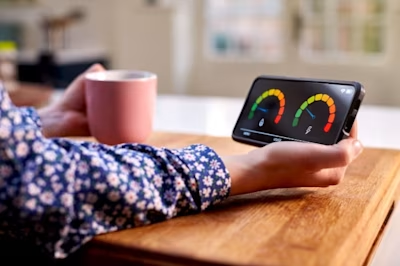
There are loads of ways you can reduce your carbon footprint and save on your energy bills:
Could you save with solar panels? Make sure you get a the best solar export rates. You can also store electricity on a solar battery - but they're not cheap. See Is solar battery storage worth it?
Looking for a new car? Consider an electric vehicle and pair it with an EV tariff.
Boiler reaching the end of its life? A heat pump is a low carbon alternative – you can get a £7,500 grant to help with the cost.
Want a green energy tariff? See Cheap Energy Club or read our Green energy guide for full info.
Below we've featured some fantastic success from MSE users who've used these guides to save money on their energy. If you've found success using our tools or guides, let us know via email.
"Thanks to your most helpful energy options information, which have just enabled us to swap dual fuel supplier. This gives us a cheaper provider than currently for two years, let alone from late August when a newer more expensive current option would kick in. "
"I have been a huge fan of Martin's money saving tips for so long now and I couldn't tell you how much I have saved/reclaimed over the years. Recently rang my energy company as I was in credit by £500 and got back £400.. "
"Thanks to your MSE website reminding us about refixing our energy. Today we managed to arrange a 2 year fixed deal for the same monthly price as the 1 year fix we had the year before!"
Traditionally, paying by monthly Direct Debit used to be the cheapest way to pay for your energy, but since April 2024, a typical prepayment bill will be about 3% cheaper for those on standard price-capped tariffs.
So if you're on the Cap, moving to prepayment will see a saving. Yet before you jump to it, a word of caution... there are rarely any prepay deals. All the big money and discounts are thrown out to win new Direct Debit customers. So for many, Direct Debit will stay by far the overall cheapest for people who switch, but for those who don't, it'll be prepay.
See our Energy Direct Debit and Prepay energy guides for more info.
If you pay for your gas and electricity together, you'll likely be on a dual-fuel tariff. The benefit of doing this is that you will only have to pay one energy provider, meaning half the admin work.
It can also be cheaper as some energy suppliers often give discounts to those who get their gas and electricity together, but that is not always the case, so it's always best to compare deals. You can do this using our Cheap Energy Club tool.
When you owe your supplier money, it can sometimes block any attempts to switch away from it. But you can switch if the debt you owe is less than 28 days old, as it'll just be added on to your final bill. For any debts older than 28 days, you'll usually have to pay this off before you switch.
If you're in debt or struggling with your bills, see our full Energy help guide.
No. It's the same gas, same electricity and same safety. Only the customer service and who bills you changes. Your supply always stays on and no one visits your home unless you want or need smart meters.
The right tariff for you depends on your usage, circumstances and preferences. For full info on whether you should consider a fixed deal, see our Should you fix? guide, or see full info on the alternatives to fixing.