




Banking for the financially vulnerable
Find a bank account that suits your needs

When you're struggling financially – whether it's because of mounting debt, low income, illness, or simply trying to make ends meet – even basic money management can feel overwhelming. And while it won't solve everything, the right bank account can help ease some of that pressure. This guide is here to help you find the best fit for your situation – and take a step toward financial control.
What does it mean to be financially vulnerable?
Being financially vulnerable means your situation puts you at greater risk of money problems – either because your income is unstable, your expenses are too high, or you're dealing with something that affects how you manage day-to-day.
This can be short-term or ongoing, and it affects people from all walks of life. Some common triggers include:

Significant life events – such as losing your job, going through a divorce, or being bereaved
Age, illness or disability – which can increase costs and make it harder to earn
Low or unpredictable income – for example, if you’re on zero-hour contracts or freelance work
Mental health or cognitive challenges – which can make managing bills or making financial decisions more difficult
If any of this sounds familiar, you're not alone – and support is available. Finding the right bank account can help reduce fees, improve visibility, and give you more control.
What are the benefits of switching bank accounts?
Switching to the right bank account can offer many benefits, including helping you to:
-
Reduce your debt: switch to a cheap or interest-free overdraft to lower your interest payments.
-
Find relevant services: find local branches offering in-person services and/or strong customer service.
-
Manage your money: find a mobile banking app with helpful features, such as budgeting tools.
-
Improve your credit: find options for poorer credit scorers & learn how to improve your credit history.
-
Max your rewards: get perks such as cashback on bills or shopping, or access to top savings rates.
Of course, switching to a more suitable bank account is unlikely to solve all your financial problems, but it can be an effective first step in regaining financial control.
How to find the right bank account for your needs
We regularly talk about banks which offer free cash (often up to £200) for switching to them, as it's a quick and easy way to boost your savings. See Best bank accounts for the latest offers and how to do it.
However, while free cash is great in the short term, it's more important to make sure you find an account that meets your needs. We'll now take you through a variety of banking products so you can find one(s) which meets your specific needs.
-
Struggling with debt or in your overdraft?
If you’re living in your overdraft, it can feel like quicksand – you pay some off, only to get dragged back by charges and interest. It’s one of the most expensive ways to borrow, and escaping it can feel impossible. But there are ways to reduce the pressure. Here's what you can do:
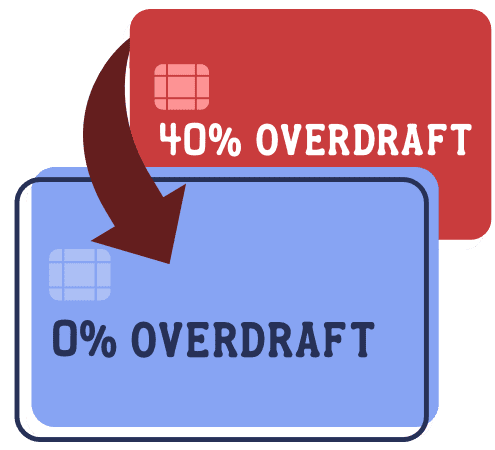
Switch to a 0% overdraft. Some banks offer interest-free overdrafts, helping reduce the amount you owe – though you’ll need to pass a credit check. Most have eligibility tools to check before applying.
Switching while overdrawn is possible. If the new bank agrees to match your overdraft, it’ll cover your old one as part of the switch. If not, you may need to clear the old overdraft first.
Remove the temptation. You can ask your bank to remove your overdraft entirely. Or consider a basic bank account, which comes with no overdraft facility at all.
More help: If you're struggling, we've much more info in our Cut overdraft charges guide. Below are some accounts which give you an idea of what's out there in terms of overdraft support...
Top bank accounts if you're overdrawn
First Direct* gives many a £250 0% overdraft (credit score dependent, and it's the standard 40% above that). Plus, if you switch your existing bank to it, you could get £175 free cash on top (see our First Direct review for full info).
The Club Lloyds account has a £100 0% overdraft (again, credit score dependent, and it's 40% above that), which could be handy if you occasionally dip into yours. However, the account is only fee-free if you pay in at least £2,000 each month, which could be difficult for many. If you can't do this, avoid this account, as the £5 monthly fee will make matters worse.
Starling Bank has tiered overdraft rates starting from 15% interest – much lower than most other banks. You can control your overdraft limit in its app, and set up spending notifications if you're about to go into (or are already in) your overdraft. The rate & limit you get are credit score dependent.
If you're not currently overdrawn but you've been in and out of an overdraft, and want to remove the option (or temptation) to fall into one again, you can usually ask your bank to remove the overdraft function on your account. There's also Basic bank accounts, which provide the usual current account features but without the option of an overdraft.
-
Prefer in-person help?
If you value in-person banking or don’t have reliable internet access, you’re not alone. But as branches continue to close - more than 1,500 branches have closed over the last three years - so it's important to know which banks still offer strong branch support, or alternatives. We've a short list of the biggest highstreet contenders, plus info on what to do if there aren't any banks open in your town anymore...
Top bank accounts offering face-to-face services
Nationwide Building Society has the most branches and has pledged to keep them open until at least Jan 2028. Plus, it's consistently received strong service feedback in almost every banking poll we've ever run.
Lloyds Banking Group (Lloyds Bank, Halifax & Bank of Scotland) has the largest group network, though it's been steadily closing branches since 2024 and has announced further closures for 2025 and 2026. Despite this, there's still a strong physical presence.
Other banks with a decent (but dwindling) number of branches includes NatWest, Santander, HSBC, Barclays and TSB.
There's also First Direct* which operates a UK-based telephony customer service team, which has consistently received very strong feedback.

What to do if my local branch has closed?
Our Local bank branch alternatives guide takes you through similar in-person services, including banking hubs, mobile & 'pop-up' bank branches and Post Office branches.
These services allow you to withdraw cash, deposit cheques, talk to someone from your bank in-person, and manage regular payments.
-
Need help managing day-to-day money?
Digital banks can make budgeting easier with real-time alerts, spending analysis and app tools – ideal if you're trying to stay on top of your finances or avoid overspending.

Every year, we run a poll asking for your opinions on the usability and features of banking apps. We ask for a rating of 'great', 'OK' or 'poor' – below are the results of our most recent poll, in April 2025, ranked by percentage great.
The digital banks which have consistently ranked near the top are First Direct*, Monzo, and Starling, as well as traditional banks NatWest, RBS & Lloyds – so we'd recommend one of these.
Top banking apps ranked by usability & featuresBank or building society
Percentage 'great'
Total responses
Top banking apps ranked by features
Monzo
86%
901
Starling
80%
815
RBS
72%
402
NatWest
68%
1,660
Lloyds
66%
1,400
Top banking apps ranked by usability
Starling
82%
816
Monzo
81%
897
First Direct
75%
1,923
RBS
73%
401
Chase
73%
1,468
These banking app ratings are from our April 2025 poll of 10,799 people. Percentages are rounded to the nearest whole number. Only banks with at least 75 responses have been included. See the full poll results for more detailed info.
-
Been refused for a standard account or have bad credit?
Basic bank accounts offer those with a poor (or no) credit history a place to store money and pay bills from. The downside is that they don't come with overdrafts, or many of the perks that standard bank accounts offer.
Crucially, there isn't usually a credit check involved, which is why they're a good option for poorer credit scorers, particularly if you've been declared bankrupt or are using a debt management product, such as an individual voluntary agreement (IVA), a debt management plan (DMP) or a debt relief order (DRO). However, you'll almost always need to provide some form of ID, such as a passport or drivers licence.
They can be opened and managed in the same way as regular current accounts – so you can find one that works for you (for example, one you can open online, or manage in branch). Our longstanding top picks include:
All three allow you to set up Direct Debits and standing orders, and give you a debit card which means you can withdraw cash from ATMs.
There are others, though banks don't always advertise them. If you're set on opening an account with a particular bank and have been rejected for its standard current account, try enquiring about its basic bank account.
Want to rebuild your credit score?
For a quick overview of the top credit scoring tips, we've guides on top tips to boost your creditworthiness and how to check your credit report for free.
Or if you prefer, watch MoneySavingExpert.com founder, Martin Lewis’ 5-minute video on how to boost your score below:

 Martin's tips to boost your credit score so you're more attractive for mortgages, cards, mobiles etc
This clip has been taken from The Martin Lewis Money Show Live on Tuesday 30 January 2024 with the kind permission of ITV Studios. All rights reserved.
-
Want perks like cashback or decent savings rates?
Reward accounts – aka cashback bank accounts – often pay you money back for using them as your main bank account – usually a percentage of what you spend on bills or shopping. To earn the cashback, you often need to pay out Direct Debits, make card purchases or use online banking.
Most have monthly fees and pay-in requirements, so always check whether the cashback and perks outweigh the costs before switching.
Top bank accounts for cashback & perks
Top fee-free account: Chase* offers newbies 1% cashback when spending on UK groceries, transport and fuel (exclusions apply), max £15/month (after year one, you must pay in £1,500/month to get this).
Top fee-paying account: Santander Edge* gives 1% back on water, energy, council tax, mobile, broadband, phone and paid-for TV bills (max £10/mth). There's a £3/month fee and you must pay in £500+/month and have 2+ Direct Debits. There's also a separate 1% debit card cashback (max £10/mth) on grocery, fuel & travel spending – but this will be ending on 9 September.
-
Can you save? Max your interest with linked savings accounts

If your situation is more stable and you have some savings – or are able to start saving – many top bank accounts come with linked savings accounts (such as regular savers) which even outpay top easy-access savings.
Sadly, many traditional banks pay paltry rates, hoping you'll think that loyalty pays (spoiler: it doesn't) – so, it's crucial to ditch & switch if you're languishing on a pants rate.
Top bank accounts for savings interest
Top easy-access savings: 6% interest. The two top-pick bank accounts for cashback (mentioned above) are also top for savings – Santander's Edge saver pays 6% variable interest on up to £4,000 for a year, while Chase's linked savings account pays 4.75% variable interest on up to £3m for a year.
Top regular savers: 7% interest. Zopa pays 7.1% variable, allows withdrawals & you can skip months, while First Direct pays 7% fixed, doesn't allow withdrawals & you must pay in every month. Both let you save £300/month.
Ready to switch? Here’s how?
The Current Account Switch Service (CASS) process is straightforward and takes just seven working days. Just open a new account with your chosen bank, then request a switch through it – you'll usually be asked during the application if you want to switch.
So long as both banks are signed up to CASS (most are, see below), your old account will be closed and your money, Direct Debits & standing orders will be automatically moved across. Any payments made to your old account will be automatically paid into the new one for at least three years. It's safe, easy & hassle-free.
Which banks and building societies are signed up to CASS?
More than 50 providers are signed up to the Current Account Switch Service (CASS):
-
AIB (NI)
-
Allica Bank
-
Allied Irish Bank (GB)
-
Arbuthnot Latham & Co
-
Bank of Ireland UK
-
Bank of Scotland
-
Barclays
-
Barclays Private
-
C. Hoare & Co
-
CardOneMoney
-
Chase Bank
-
Clydesdale Bank
-
Co-operative Bank
-
Coutts
-
Coventry Building Society
-
Cumberland Building Society
-
Danske Bank
-
First Direct
-
Habib Bank Zurich
-
Halifax
-
Hampden Bank
-
Handelsbanken
-
HSBC CIIOM
-
HSBC Private Bank
-
HSBC UK Bank
-
Investec Bank
-
Isle of Man Bank
-
Lloyds Bank
-
Lloyds International
-
Lloyds Private Bank
-
Metro Bank
-
Monzo
-
Nationwide Building Society
-
NatWest
-
NatWest International
-
Reliance Bank
-
Rothchild & Co
-
Royal Bank of Scotland
-
Santander
-
Smile
-
Starling Bank
-
Thinkmoney
-
Tide
-
Triodos Bank
-
TSB Bank
-
Ulster Bank
-
United National Bank Ltd
-
Unity Trust Bank
-
Virgin Money
-
Weatherbys Bank
-
Yorkshire Bank
-
Zempler Bank
Last updated: March 2026.
Other banking products for the financially vulnerable
If none of the above bank accounts meet your needs, it may be that you need a more niche banking product. We briefly explain a variety of options below, but within each section there's a link to our bespoke guide which has full information, should you need it.
Power of Attorney accounts
If you have Power of Attorney and manage somebody else's finances, choosing the best bank for day-to-day use and any savings can be a challenge. Our Best banks if you have Power of Attorney guide has full bank-by-bank help on how to register for access to existing accounts, plus the easiest banks to deal with if you're looking to open a new account.
Credit unions and community banks
Credit unions, also sometimes called community banks, offer an alternative to traditional banks and building societies for saving and borrowing – especially if you've found it tricky to access financial products in the past. Our Credit unions guide explain what credit unions do, who can use them and what they can offer.
Delegated spending cards
Some specialist cards allow others to spend on your behalf while you stay in control – for example, by setting spending limits. These can be useful if you rely on others to shop for you, or if you assist a vulnerable person and want them to be able to spend safely. Our Delegated spending cards guide takes you through this topic in full.
Budgeting tools
The problem with most budgets is they don't work. While they look at a typical month's spending, what about birthdays, that dentist visit you have to pay for and other one-offs? Our Budget planning guide gives you some helpful tips and tricks and includes a free Budget Planner, which analyses your finances to help you manage and control your cash.
Packaged bank accounts
The Marmite of banking – some love 'em, some hate 'em. They're a premium banking product, so they usually have expensive monthly fees. But, used right, they can save you £100s off the cost of breakdown, travel and mobile insurance. Our Top packaged bank accounts guide will help you check if they're right for you, and show you the top picks.
Struggling with debt?
Firstly remember that your debt problem isn't unsolvable. It might not be easy or quick to resolve, but there's always a route. And the earlier you tackle your debts, the easier they are to deal with. Our Debt problems & help available four-step guide shows you where to start and how to get free one-on-one help.
FAQs
Can I open a bank account if I’ve got bad credit or past debt with a bank?
Yes – even if you’ve been rejected before or owe money to a bank, you can usually open a basic bank account, which doesn't require a credit check. These accounts don’t offer overdrafts or rewards, but they let you receive money, pay bills and use a debit card safely.
Do I need photo ID or proof of address to open an account?
Most banks ask for photo ID and proof of address, but if you don’t have them, some accept alternatives (like benefit letters or tenancy agreements). If you’re struggling with this, ask the bank what they can accept – or try your local credit union, which may be more flexible.
Can I still switch bank accounts if I’m overdrawn?
Yes – many banks let you switch even if you're overdrawn. If the new bank agrees to match your overdraft, it’ll pay off the old one as part of the switch. Use eligibility checkers first to see if you’re likely to be accepted.
Will switching affect my credit score?
Opening a new current account can show as a hard or soft search on your credit file, but it usually has little to no long-term impact. Managing the new account well may even help improve your score over time.
What if I don't have access to the internet or a smartphone?
Some banks still offer branch-based or telephone banking services. You can also do everyday tasks like withdrawing cash and checking your balance at many Post Office branches. See our section on face-to-face support for options.
What can I do if I'm struggling with debt?
Many people struggle with debt. But even if you're struggling to make ends meet, your debt problem isn't unsolvable. It might not be easy or quick to resolve, but there's always a route. And the earlier you tackle your debts, the easier they are to deal with. Our Debt problems & help available four-step guide shows you where to start and how to get free one-on-one help.
Share this guide?